
On the Monday after Pentecost, we celebrate the Memorial of Mary, Mother of the Church, honoring Mary’s role in guiding the faithful. After Mary was granted the title “Mother of the Church” by Pope Paul VI in 1964, Pope Francis later decreed that the Monday after Pentecost be celebrated as a feast to “The Blessed Virgin Mary, Mother of the Church.”
In our latest post, we invite you to explore four places Mary is depicted as the Mother of the Church in the art of the Basilica, from the Our Lady of Ephesus Oratory to the Mary, Queen of Missions Chapel.
 The West Tympana
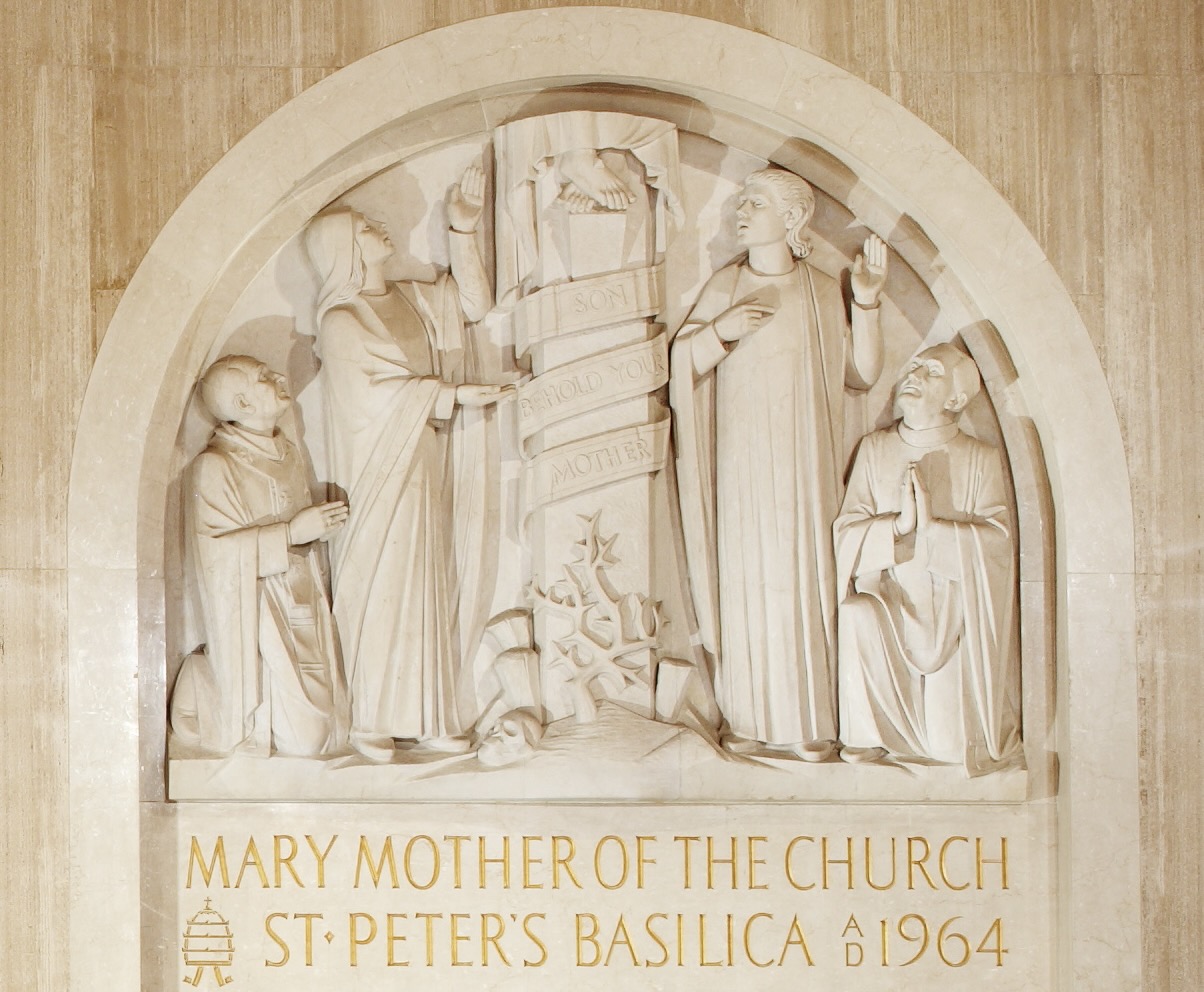
It was at the end of the Second Vatican Council that St. Paul VI declared Mary the Mother of the Church, saying:
“[W]e proclaim the Most Blessed Mary Mother of the Church, that is to say of all the people of God, of the faithful as well as of the pastors, who call her the most loving Mother. And we wish that the Mother of God should be still more honored and invoked by the entire Christian people by this most sweet title.”
In the West Tympana of the Great Upper Church, this moment is portrayed in white marble alongside other significant events in the development of Marian doctrine, including the teaching of Mary as the Mother of Holy Hope, and the definition of the Immaculate Conception. Here, Mary is depicted at the foot of the Cross, her eyes raised up towards her son.
The Universal Call to Holiness Sculpture
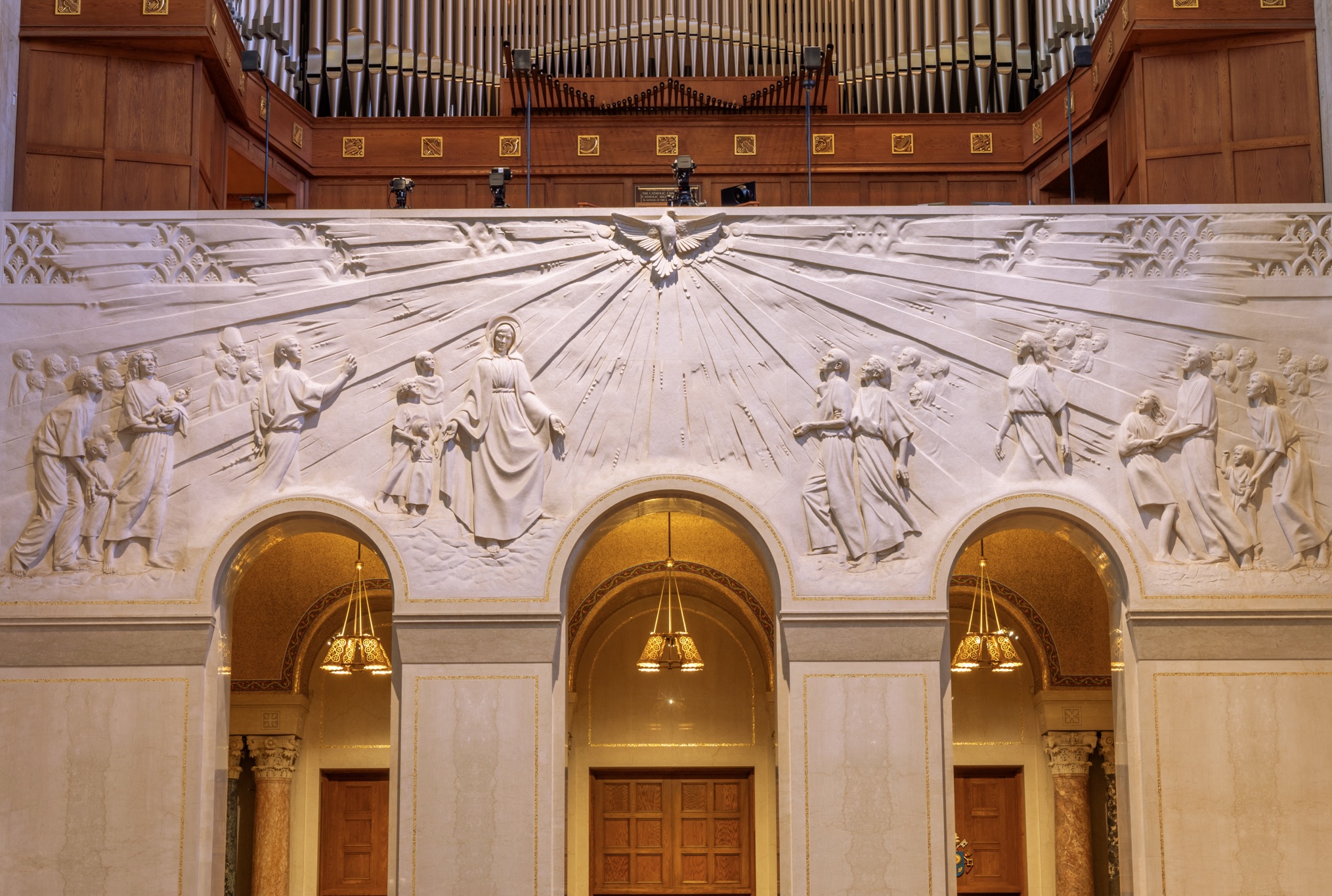 In the Great Upper Church, you can also find Mary portrayed as Mother of the Church in The Universal Call to Holiness Sculpture. One of the largest relief sculptures in the world, it offers an awe-inspiring visualization of a profound spiritual reality: that the call to holiness extends to the faithful in all times and places. As expressed in §40 of the dogmatic constitution “Lumen Gentium”:
“All the faithful of Christ of whatever rank or status, are called to the fullness of the Christian life and to the perfection of charity; by this holiness as such a more human manner of living is promoted in this earthly society.”
Weighing over 37 tons and spanning 780 square feet, the relief portrays people of all ethnicities, ages, rank, and status being drawn to the Holy Spirit. In this depiction, Mary stands near the center, beneath the wings of the Holy Spirit, leading the faithful to walk in holiness. The almost 50 figures depicted include Pope John Paul II and Mother Teresa of Calcutta.
Today, The Universal Call to Holiness remains a focal point of the Basilica’s nave, inspiring the congregants of America’s Catholic Church to pursue holiness in their own lives.
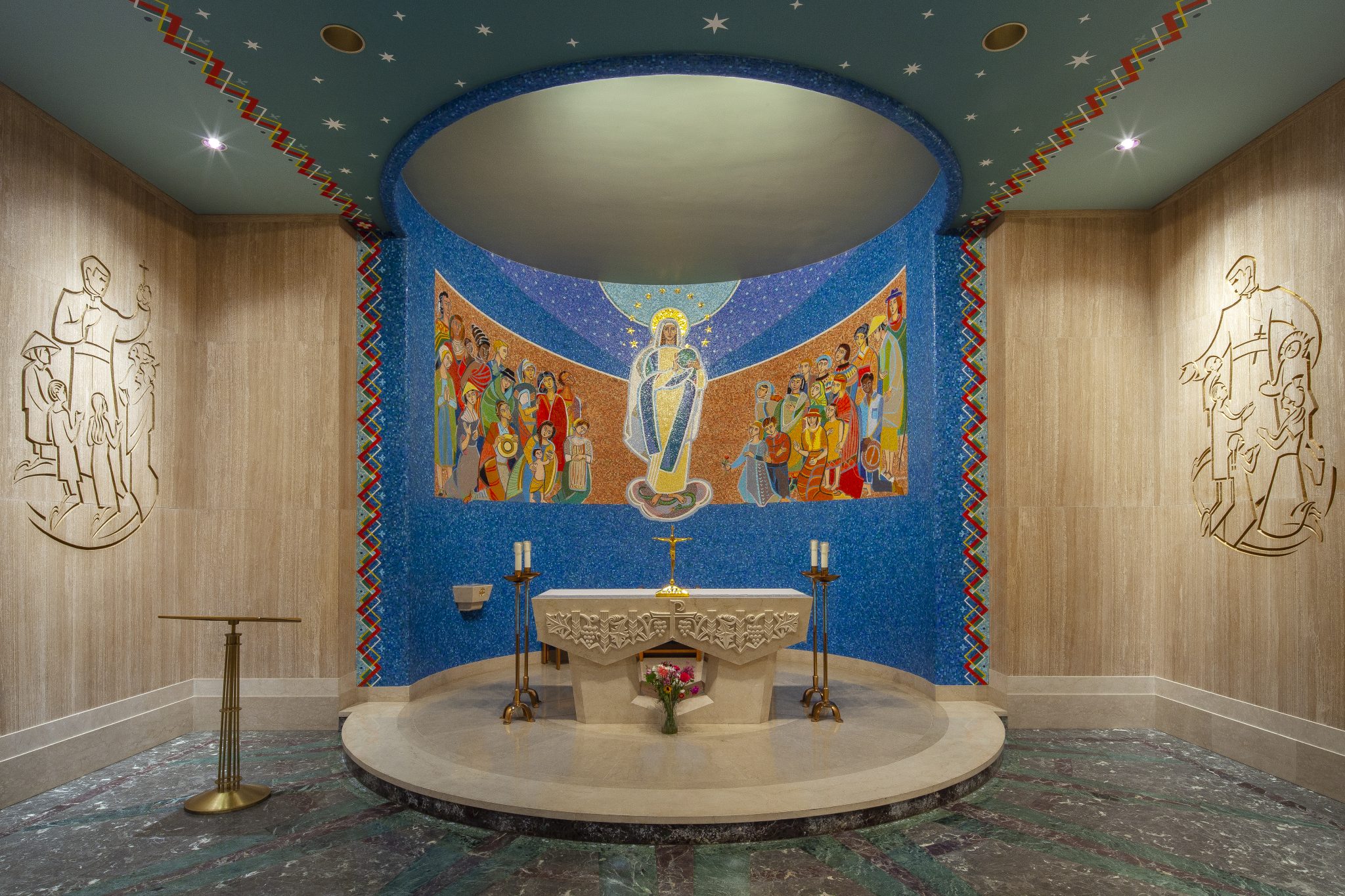 The Mary, Queen of Missions Chapel
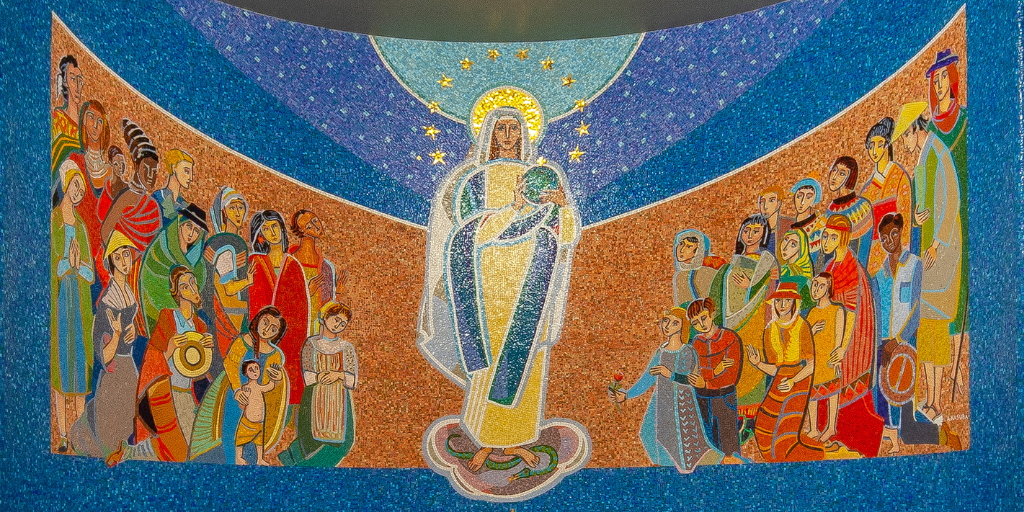
Located in the Crypt level of the Basilica, the Mary, Queen of Missions Chapel honors Mary’s role in directing unbelievers to Christ and equipping the faithful to carry out the Great Commission. In this Venetian glass portrayal, Mary is crowned with 12 stars and holds a globe surmounted by a cross, with the moon and the serpent beneath her feet. She is surrounded by people from continents and cultures evangelized by the Oblates of Mary Immaculate, including regions in the Asian-Pacific, South America, and the Arctic Circle.
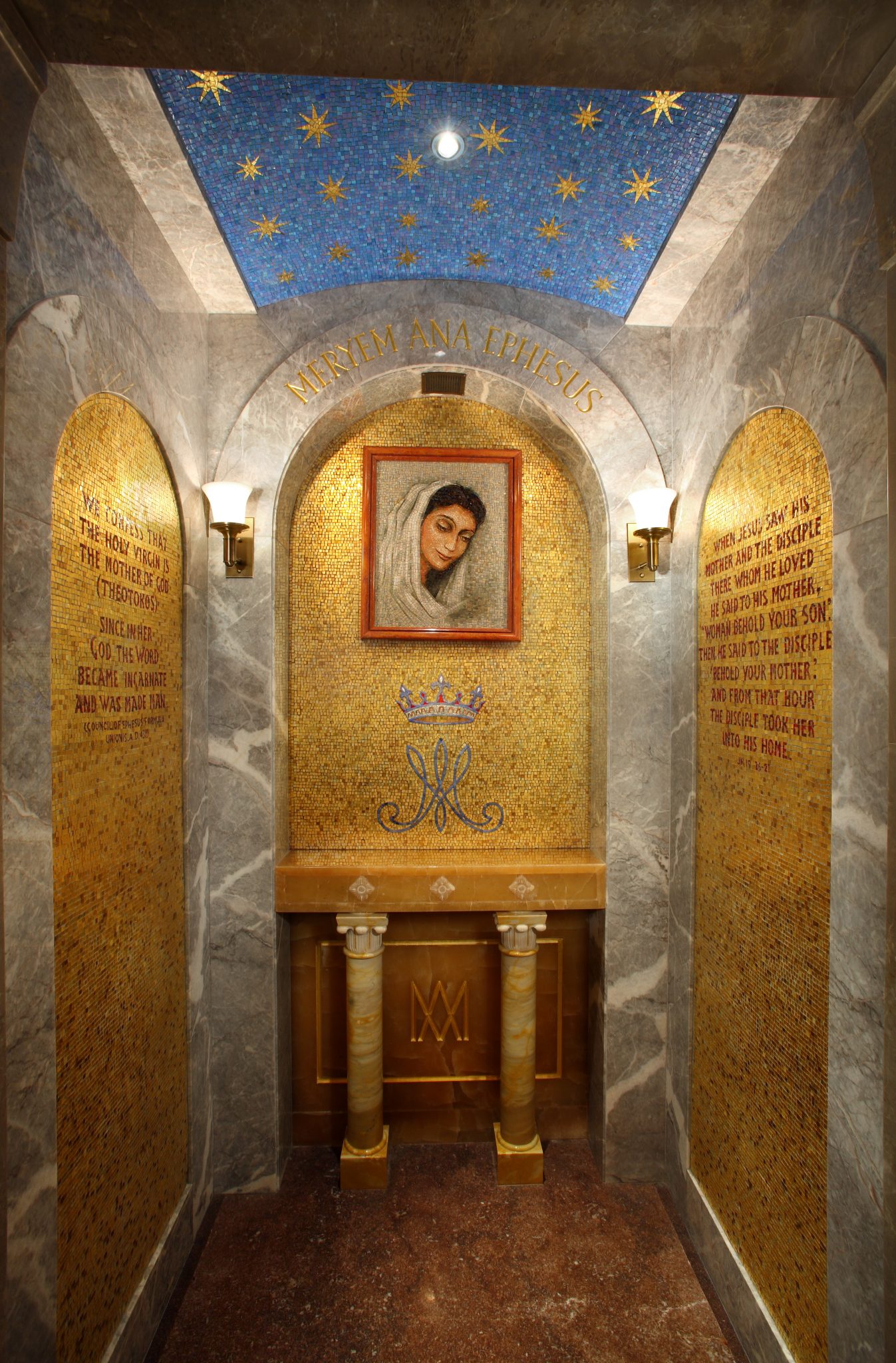 The Our Lady of Ephesus Oratory
Located in the Crypt Church, the Our Lady of Ephesus Oratory features a mosaic of the Blessed Mother surrounded by gold tiles and a shimmering blue ceiling spangled with golden stars. Through its simply beauty, this oratory creates a sense of serenity, inviting the visitor into a moment of peace and contemplation.
The devotion to Our Lady of Ephesus was inspired by Mary’s role in the early development of the Church. According to tradition, after Christ was crucified, Mary lived with John in his home at Ephesus (modern-day Turkey), where she helped nurture the early Church. Later, in A.D. 431, at the Council of Ephesus, the Church formally recognized Mary’s role in the Incarnation, declaring her to be the Theotokos – “the God bearer.”
Source:
Rohling, Geraldine M., PhD, MAEd. The Basilica of the National Shrine of the Immaculate Conception: Guide and Tour Book. Washington, D.C.: Basilica of the National Shrine of the Immaculate Conception, 2018.