
This month, we’re delighted to share the eighth post in our Walk Through Art blog series, highlighting the sacred art of the Basilica as it corresponds to important Church celebrations and moments in the life of the National Shrine. In this post, we invite you to discover four art pieces we’re highlighting this April – from the Our Lady of Ephesus Oratory to the Resurrection mosaic!
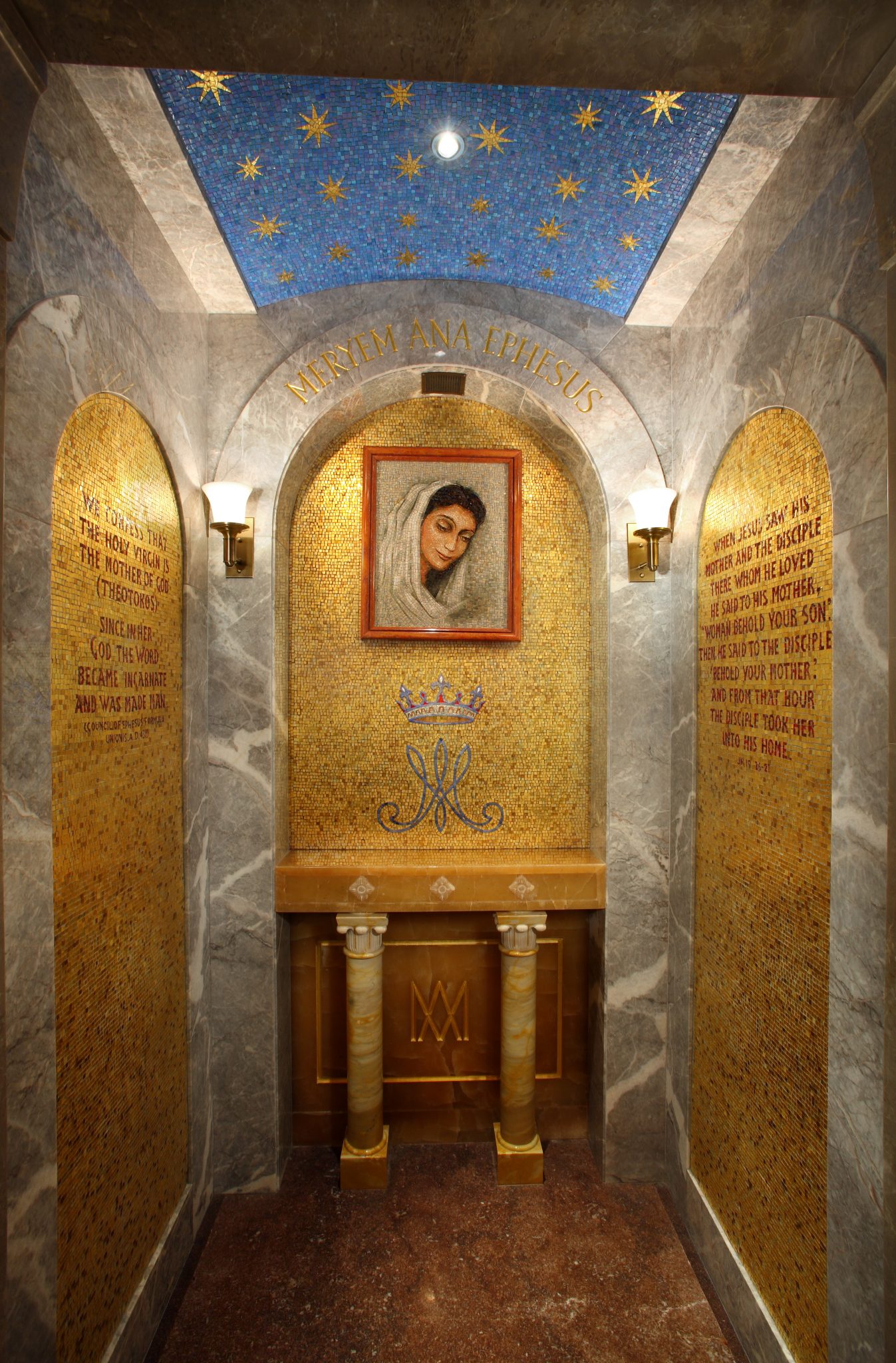 April 4 – The Our Lady of Ephesus Oratory
On April 4, 2003, the Our Lady of Ephesus Oratory was dedicated at the Basilica. Located in the Crypt Church, it features a mosaic of the Blessed Mother surrounded by gold tiles and a shimmering blue ceiling spangled with golden stars. Through its simply beauty, this oratory evokes a graceful serenity, inviting the visitor into a moment of peace and contemplation.
The devotion to Our Lady of Ephesus was inspired by Mary’s role in the early development of the Church. According to Catholic tradition, after Christ was crucified, Mary lived with John in his home at Ephesus (modern-day Turkey), where she helped nurture the early Church. Later, in A.D. 431, at the Council of Ephesus, the Church formally recognized Mary’s role in the Incarnation, declaring her to be the Theotokos – “the God bearer.”
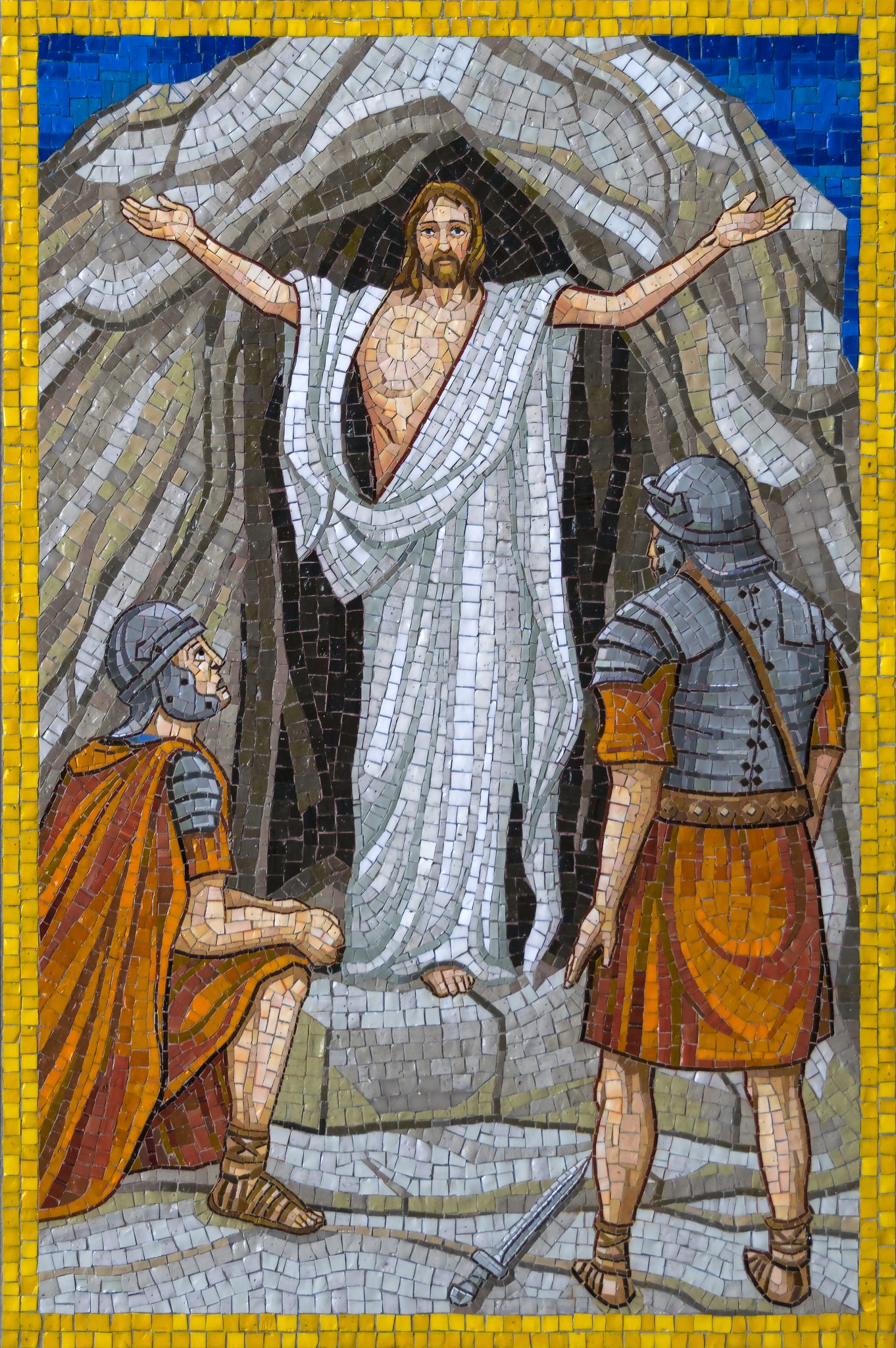
April 5 – Easter Sunday – The Resurrection Mosaic
In the first arch of the brilliant Rosary Garden mosaics, you can find the Resurrection portrayed alongside other mysteries of the Rosary. This powerful mosaic shows the guards watching in awe as Christ emerges triumphant from the tomb, victorious over death. As 1 Peter 3:18 declares:
“For Christ also suffered for sins once, the righteous for the sake of the unrighteous, that He might lead you to God. Put to death in the flesh, He was brought to life in the spirit.”
The gold border on the mosaic indicates that it is one of the Glorious Mysteries.
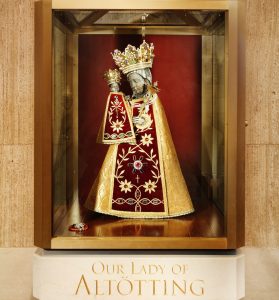 April 16 – The Our Lady of Altötting Oratory
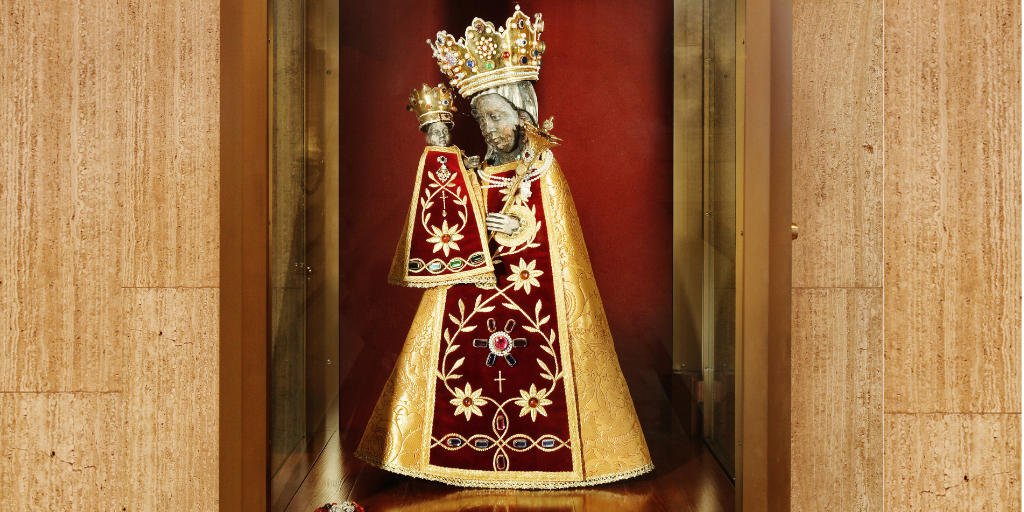
This year, April 16 marks the 21st anniversary of the dedication of the Basilica’s Our Lady of Altötting Oratory. Located in the Great Upper Church, it features a statue hand-carved from Lindenwood and clad in traditional Bavarian baroque-style robes handmade by Cistercian nuns. The deep red and gold tones, as well as the jewel-studded embroidery, heighten the regal aura pervading this portrayal of the Blessed Mother and Jesus.
The devotion of Our Lady of Altötting dates back to the 14th century and comes from the German region of Bavaria. During World War II, craftsman Josef Neustifter of Eggenfelden, Bavaria, carved an exact copy of the statue to reside in the Holy Chapel in Altötting while the original was hidden in a safe location. After the war, the original statue was returned to its place. Neustitfter made an additional four replicas, one of which now resides at the Basilica.
During his visit to the Basilica in 2008, Pope Benedict XVI spent time praying at the Our Lady of Altötting Oratory on the third anniversary of its dedication.
April 26 – The Our Mother of Good Counsel Chapel
Dating to the 15th century, the tradition of Our Mother of Good Counsel began during the Turkish offensive in Albania, when the church of Scutari was destroyed and a fresco of the Madonna and Child went missing. Tradition holds that, later that year, in Genazanno, Italy, the faithful were celebrating the feast of St. Mark when they heard ethereal music, a cloud descended, and all the bells of the town began to ring. When the cloud dissipated, the fresco was standing on an unfinished wall of the church on a slim piece of plaster. After its migration, the fresco remained intact for many years, even surviving the assault on the building during World War II, and came to be known as Our Mother of Good Counsel.
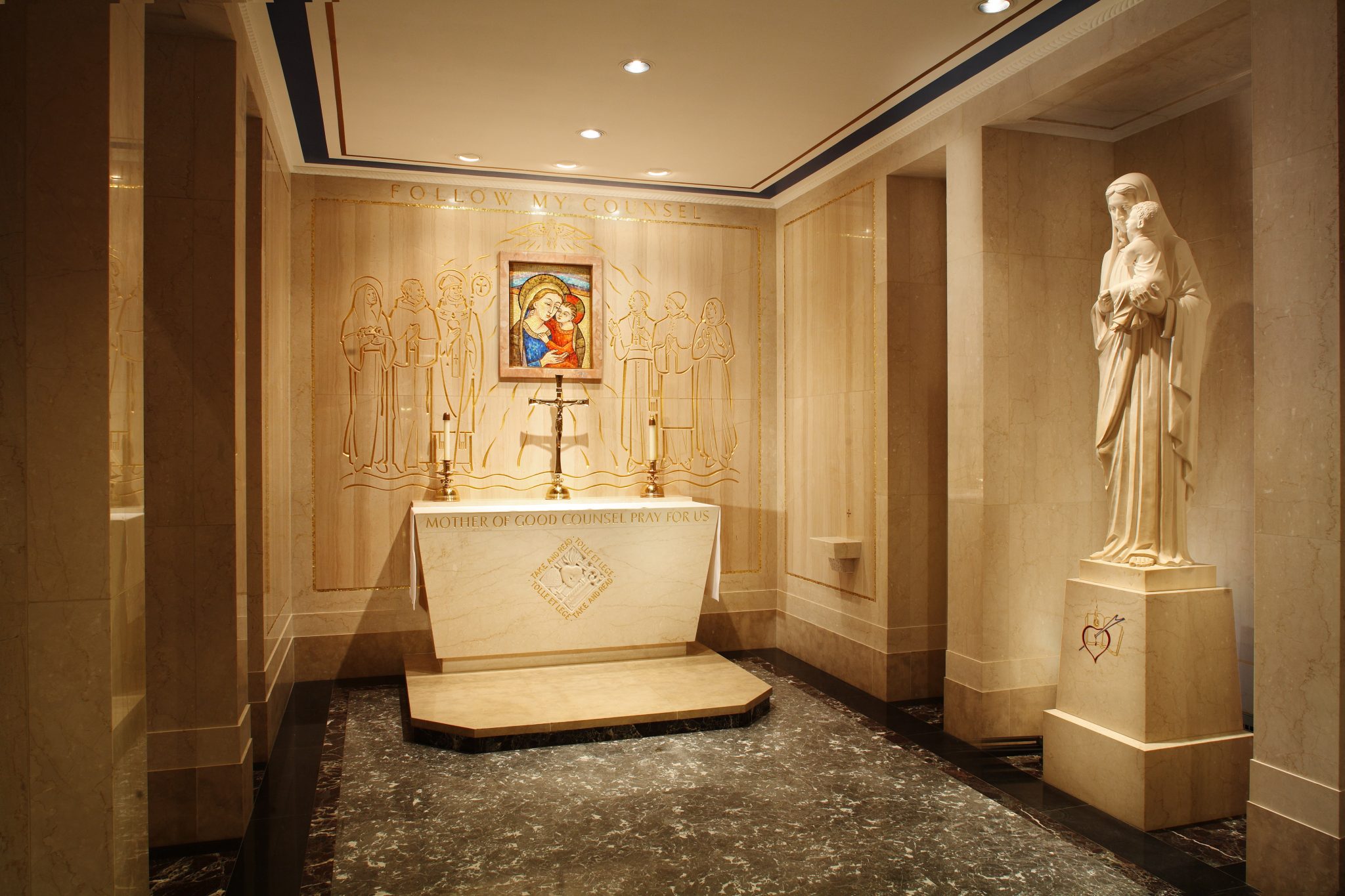 The Our Mother of Good Counsel Chapel, which was dedicated 61 years ago, on April 26, 1965. This vibrant mosaic is an example of the Eleousa (Tender Touch) type of portrayal, where Mary is depicted in a gentle, intimate pose, embracing the Christ Child. Surrounding the mosaic are depictions of men and women who were devoted to Our Mother of Good Counsel, including St. Rita of Cascia, Blessed Stephen Bellesini, St. Augustine, Pope Leo XIII, Pope Paul II, and Petruccia dei Nocera. Carved into the altar is the Augustinian seal of the burning heart, mitre, and crosier, with the command: “Take and Read.” To the right of the altar, Our Mother of Good Counsel is sculpted in Trani marble.
Source:
Rohling, Geraldine M., PhD, MAEd. The Basilica of the National Shrine of the Immaculate Conception: Guide and Tour Book. Washington, D.C.: Basilica of the National Shrine of the Immaculate Conception, 2018.