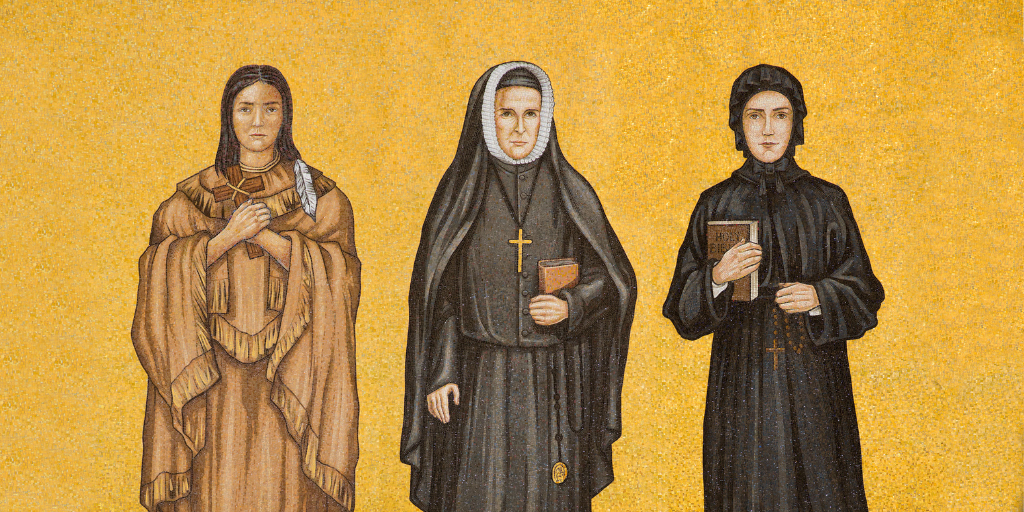
Did you know that the first American to be canonized a saint was a woman? In 1946, Pope Pius XII canonized St. Frances Xavier Cabrini, marking a historic moment for American Catholics. Throughout history, American women have played a significant role in furthering the kingdom at home and abroad, whether they were caring for the underprivileged, establishing schools, or sharing the Gospel.
This Women’s History Month, we invite you to explore the stories of five American women who became saints, from St. Marianne Cope to St. Rose Philippine Duchesne!
1. St. Kateri Tekakwitha
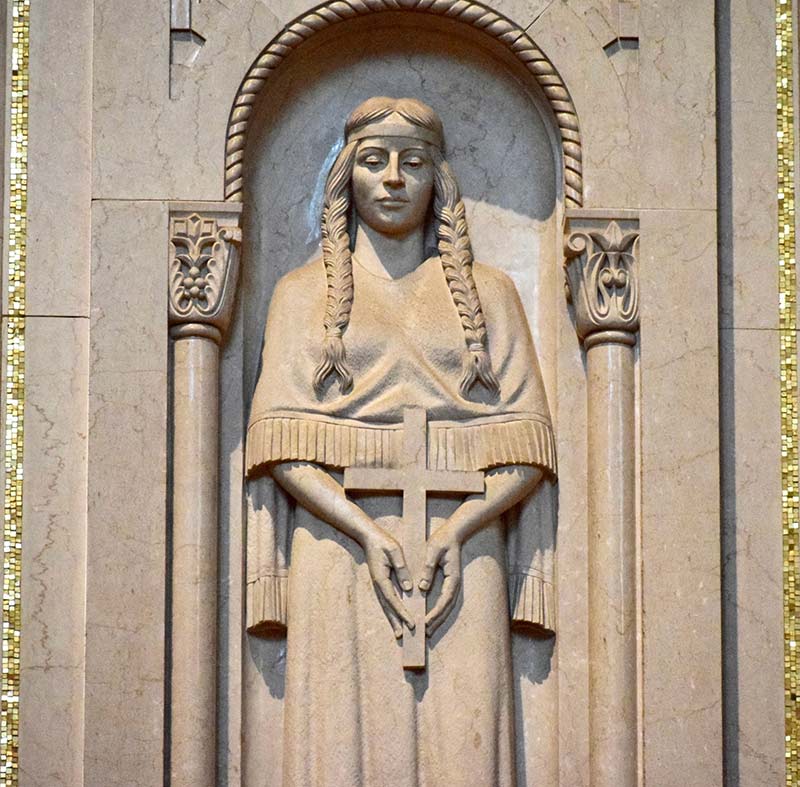
St. Kateri Tekakwitha was the first Indigenous American to be canonized as a saint. Known as the “Lily of the Mohawks,” she is the patroness of ecology and the environment. Born to a Mohawk chief in 1656, Kateri was left an orphan at age four after an epidemic of smallpox took both her parents and her brother. She was raised by her uncle in a Mohawk tribe community, and in 1676, Kateri was baptized by Father Jacques de Lamberville, a Jesuit missionary. Kateri became a devoted Christian, and at age 19, she took a vow of chastity. While her exemplary piety served as an inspiration to some of those around her, others harassed her because of her faith.
Seeking a less hostile environment, she moved to the settlement of the Mission of St. Frances Xavier, a community of Christian indigenous Americans living near what is now Montreal. There, she grew in faith and holiness, spurred on by an unquenchable zeal for Christ, living in prayer and penitence. Only five years later, however, she was called home by the Lord, passing away at the young age of 24 on April 17, 1680. Her last words were: “Jesus, I love you.”
In the Basilica, you can find St. Kateri portrayed in the Hall of American Saints, the Trinity Dome, the Our Lady of Guadalupe Chapel, and the southwest nave bay in the Upper Church.
2. St. Elizabeth Ann Seton
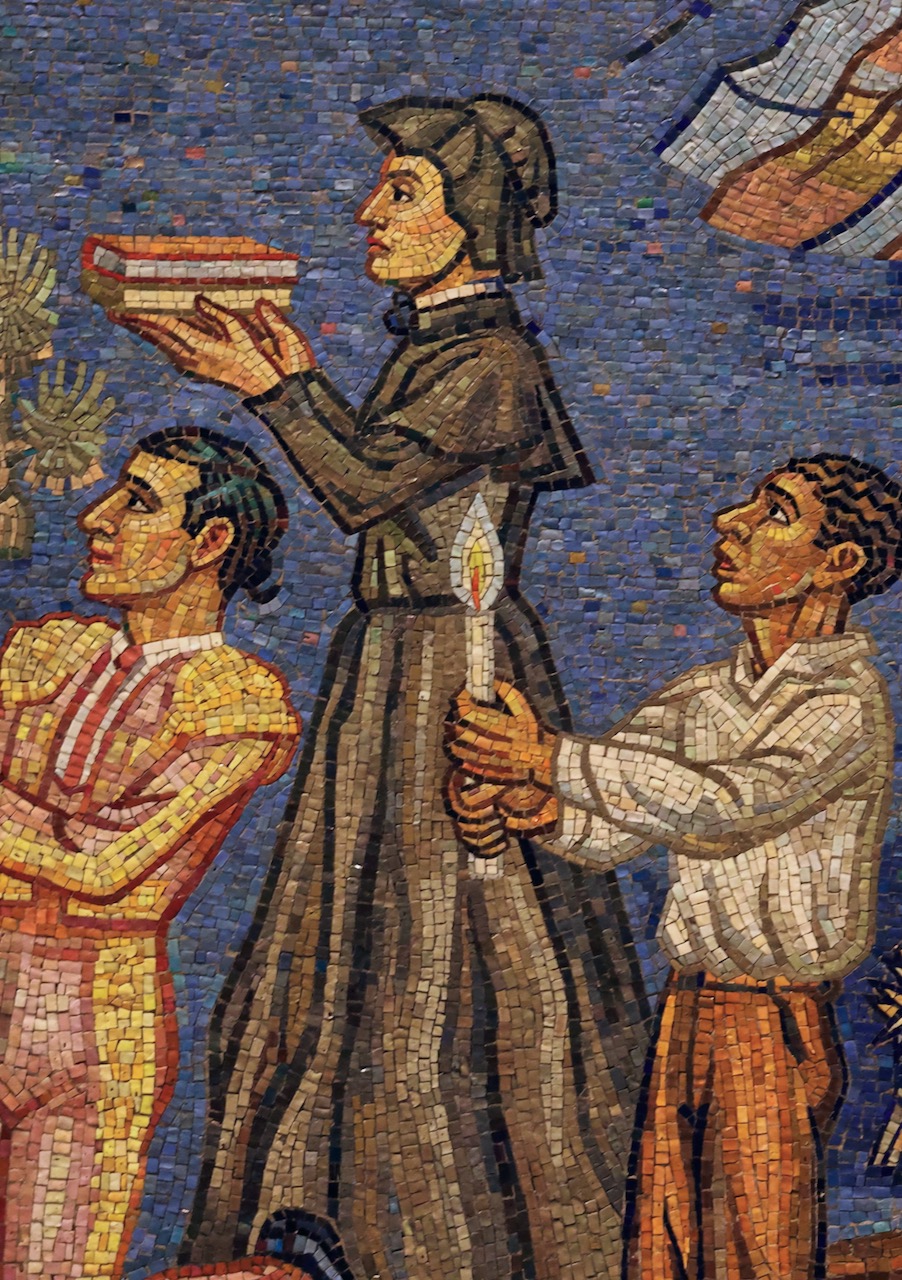
The first native-born American citizen to be canonized as a saint, Elizabeth Ann Seton is best known for her role in starting the parochial education system in America. Born on August 28, 1774, on Staten Island, Elizabeth was originally raised in the tradition of the Episcopal church. After spending time in Italy, she was struck by the beauty of Catholicism and converted in 1805. Following her husband’s premature death, Elizabeth started a Catholic school for girls in Baltimore, Maryland, at the request of a priest. Elizabeth’s most lasting impact, however, was the founding of the Sisters of Charity of Saint Joseph’s in 1809 – the first religious order in America. This order helped hospitals and orphans, but its most prominent work was in establishing the parochial education system in America. Elizabeth’s devotion to educating children and caring for the less fortunate has had an impact lasting well beyond her own life.
In the Basilica, you can find St. Elizabeth Ann Seton depicted on the exterior tympana of the West Façade, the Hall of American Saints, a Miraculous Medal Chapel window, the Our Lady of Guadalupe Chapel, and the Trinity Dome Mosaic.
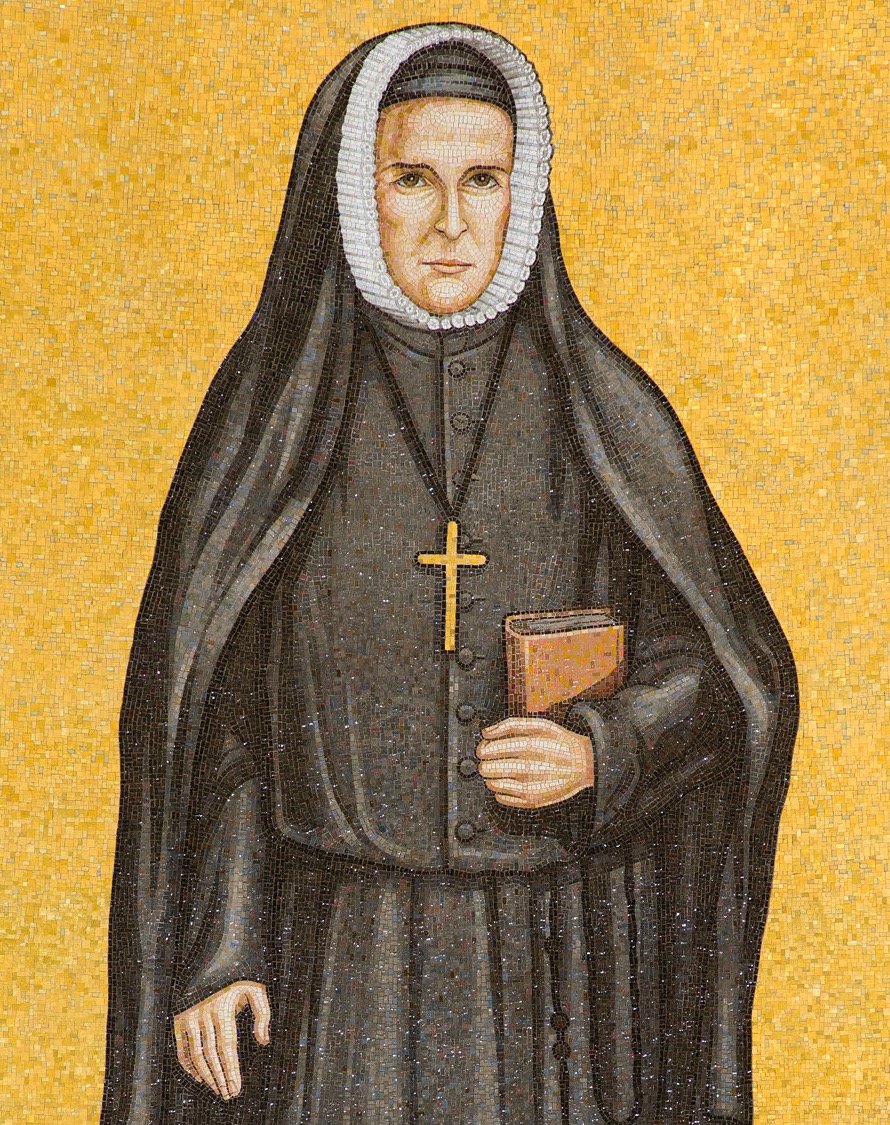
3. St. Rose Philippine Duchesne
On August 29, 1769, St. Rose Philippine Duchesne was born in Grenoble, France. When she was 18, she joined the Convent of the Visitation of Saint Marie d’en Haut as a novice. A few years later in 1804, she joined the Society of the Sacred Heart of Jesus, where she felt a deep calling to pursue missions. Yet despite the sense of urgency she felt, Rose Philippine was unable to pursue foreign missions until 12 years later.
In 1818, Rose Philippine finally traveled to St. Charles, Missouri, with five other women to found the first order of the Society of the Sacred Heart outside of France. The mission was not without challenges: Rose Philippine had trouble learning English and interacting with the Native Americans, and also faced financial difficulties. She founded the first free school west of the Mississippi that year, and within the decade, founded six houses.
In 1852, Rose Philippine passed away at age 83. She is honored in the Basilica in a statue in Memorial Hall and in the Trinity Dome mosaic. In 1988, Rose Philippine Duchesne became the fourth citizen of the United States to be canonized.
4. St. Marianne Cope
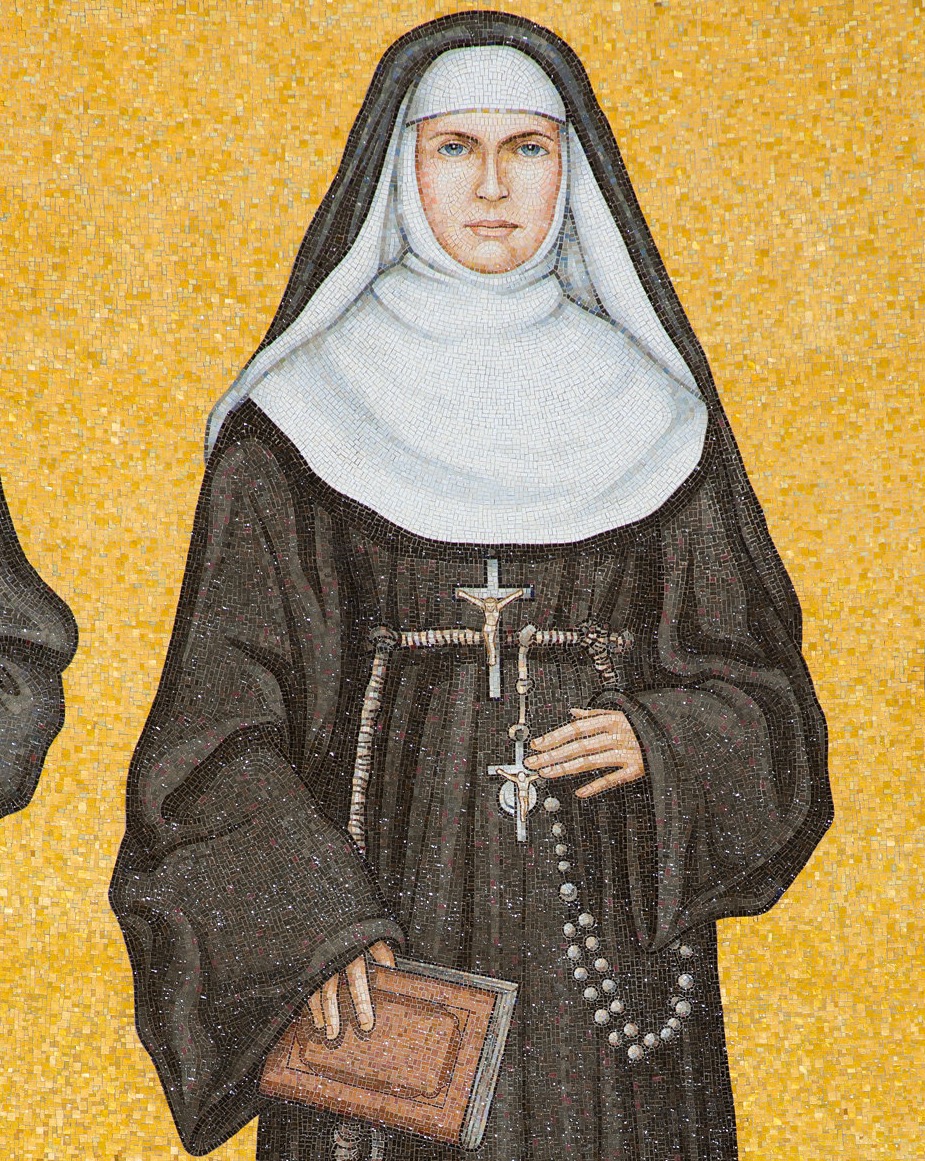
Though Barbara Koob was born in West Germany on January 23, 1838, her family moved to the United States and settled in Utica, New York, less than a year later. When Barbara was about 13, her father fell ill, so she began working in a factory to help provide for her parents and nine siblings. It wasn’t until she was 24 that she finally realized her dream of pursuing religious life and became a member of the Sisters of St. Francis in Syracuse, where she was given the name Marianne Cope. For a few years, Marianne served as an elementary school teacher and principal before taking on a position that would drastically change her life. Working as an administrator on the governing boards of the Franciscan Sisters, Marianne used her new position and skills to help establish two of the first hospitals in central New York. Her work in this role garnered the notice of a Catholic priest, who requested she come to the Hawaiian Islands to help provide education and healthcare to the leper community.
Marianne readily accepted and travelled to Honolulu in 1883. There, she served as manager of the Kaka’ako Branch Hospital on Oahu, working with the Sisters to improve patient treatment and living conditions, and expanding the hospital’s care to include the family members of lepers, who often had difficulty finding doctors to treat them. When the government quarantined all the lepers on the island of Molokai, Marianne chose to dedicate her life to caring for them, overseeing the operations of the two children’s homes. The work was alienating, exhausting, and oftentimes more than the small team could handle. Nevertheless, they continued dedicating their life to the people of the island. She also cared for Damien De Veuster following his diagnosis with leprosy, and continued to minister in Hawaii until her death on August 9, 1918. She was canonized by Pope Benedict XVI in 2012.
5. St. Frances Xavier Cabrini
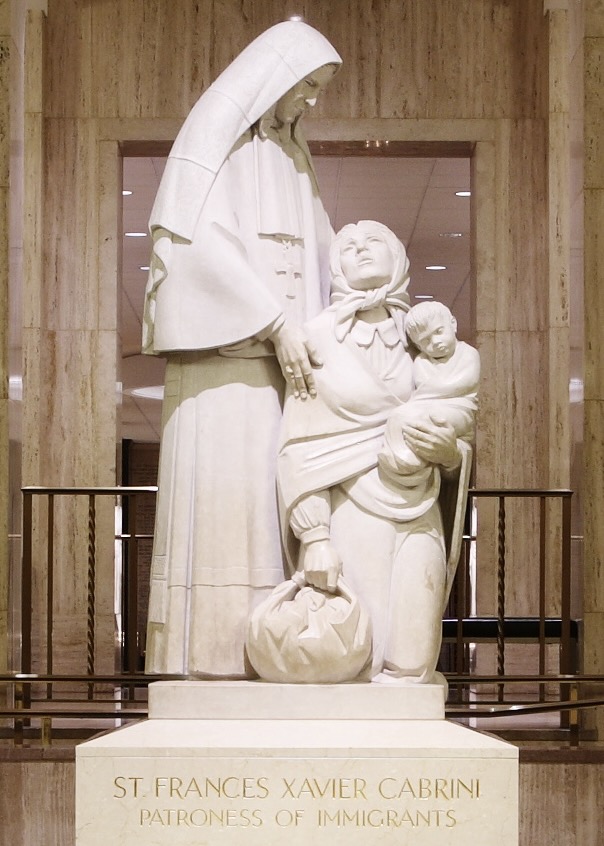
Often referred to as the mother of women’s missions, St. Frances Xavier Cabrini felt called to be a missionary from an early age. As a young girl in Italy, she would dress her dolls as nuns and send them down the river in boats as “missionaries.” She never lost her heart for missions, and at 27, approached a local bishop about the matter. At his suggestion, she founded the first institute for female missionaries: the Missionary Sisters of the Sacred Heart. Within a decade, it was recognized by Rome. When she was 30, she immigrated to New York City with six of her Sisters, intending to found orphanages in Little Italy. The plan was initially met with resistance from New York’s archbishop – primarily due to lack of funds. Regardless, Frances managed to secure $5,000 for the endeavor and was soon caring for over 400 orphans from the city streets. Later, she acquired 150 acres of land and established an orphanage in the countryside.
The Missionary Sisters of the Sacred Heart went on to found a variety of Catholic institutions throughout Europe and the Americas. In her lifetime, Frances traversed the ocean 39 times, founding over 60 missions across Europe and the Americas. In 1946, she became the first American citizen to be canonized, and today, she is recognized as the patroness of immigrants.
In the Basilica, you can find St. Frances Xavier Cabrini portrayed in the west portico, the Our Lady of Guadalupe Chapel, the Trinity Dome mosaic, and in a sculpture in the Hall of American Saints.