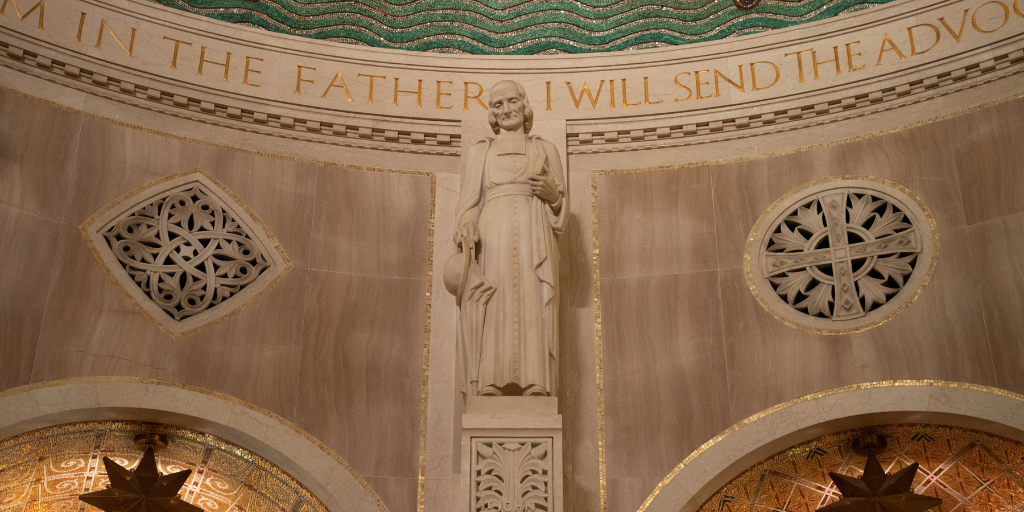
School doesn’t come easily to everyone. Throughout history, there have been saints who met with adversity, struggled academically, or were underestimated by their peers – like Thomas Aquinas, who was called a “dumb ox” by his fellow students, and John Vianney, who failed his exams for the priesthood. They could have given up all hopes of scholarship and pursuit of the consecrated life, but they didn’t. And by the grace of God, they went on to impact countless lives through their work.
As we draw near to the start of a new school year, we invite you to be encouraged by the stories of three saints who were once students – and the marvelous work they went on to accomplish!
1. St. Thomas Aquinas
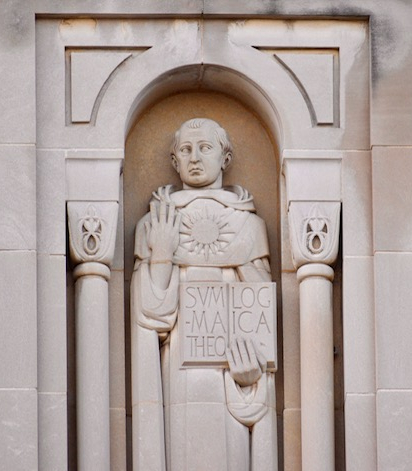
Born in northern Italy in 1225, Thomas Aquinas began religious training early on, studying at a monastery school in Monte Casino at age five. He went on to continue his education at the University of Naples and joined the Dominican Order – a decision that was met with so much hostility from his family that they kidnapped him and held him captive for a year! But after realizing that Thomas would not be deterred, his parents finally released him, and he rejoined the Dominican Order of Preachers. He continued to study at the University of Cologne, where he was a brilliant, yet quiet and withdrawn student. Deceived by his bulky form and reserved disposition, his fellow students called him “the Dumb Sicilian ox.” But his teachers knew better. “One day,” remarked one of his professors, “the lowing of this ‘Dumb Ox’ will be heard around the world.” True to the prediction, Thomas went on to receive his doctorate from the University of Paris, where he held the chair of theology, and began a prolific career writing, teaching, and preaching.
In 1266, Thomas began writing Summa Theologiae, his magnum opus. The first systematic treatment of Catholic doctrine, the work demonstrated the coherent logic of Christian thinking, relying on arguments from reason to prove spiritual truths such as the existence and characteristics of God. Though the Summa ultimately remained unfinished, Thomas provided a philosophical framework for natural law that would shape seven centuries of Catholic theology.
2. St. Isidore of Seville
The son of Spanish nobles, St. Isidore of Seville was born in 560. As a boy, he received much of his instruction from his brother, Leander. Unfortunately, Leander was a stern master, and often used punishment when his brother did not learn quickly enough. At one point, Isidore was so hurt and intimidated that he ran away. But while he was in the wild, he saw something that would change his outlook both on learning and his relationship with his brother. Water was dripping onto a rock – and though in the immediate moment, it seemed to make no mark on the rock, upon closer inspection, he saw that the water had eroded holes in the rock over time. Perhaps the task of learning – and of softening his brother’s heart – could be successful, if only he worked at it consistently, little by little.
Leander was still harsh with Isidore after his return. However, Isidore not only continued to work with him, but finished some of his projects following his death. After Leander’s passing, Isidore served as bishop for 37 years, using his role to expand the educational system, advocating to establish a seminary in every diocese in Spain. He also broadened the range of subjects taught at these institutions, encouraging the inclusion of subjects such as medicine, the liberal arts, law, and more.
Isidore’s achievements in academia and church government had an impact lasting far beyond his own life. Dubbed “the schoolmaster of the Middle Ages,” Isidore produced a diverse and impressive body of scholarship. His encyclopedia, The Etymologies, was a foundational text for a millennium, and he wrote on subjects ranging from astronomy and geography to law and theology! In ecclesial matters, he arranged synods to make decisions, likely paving the way for the future of representative governments in Europe.
Before his death at age 80, he had given all he owned to the poor. Today, he is known as a Doctor of the Church.
3. St. John Vianney
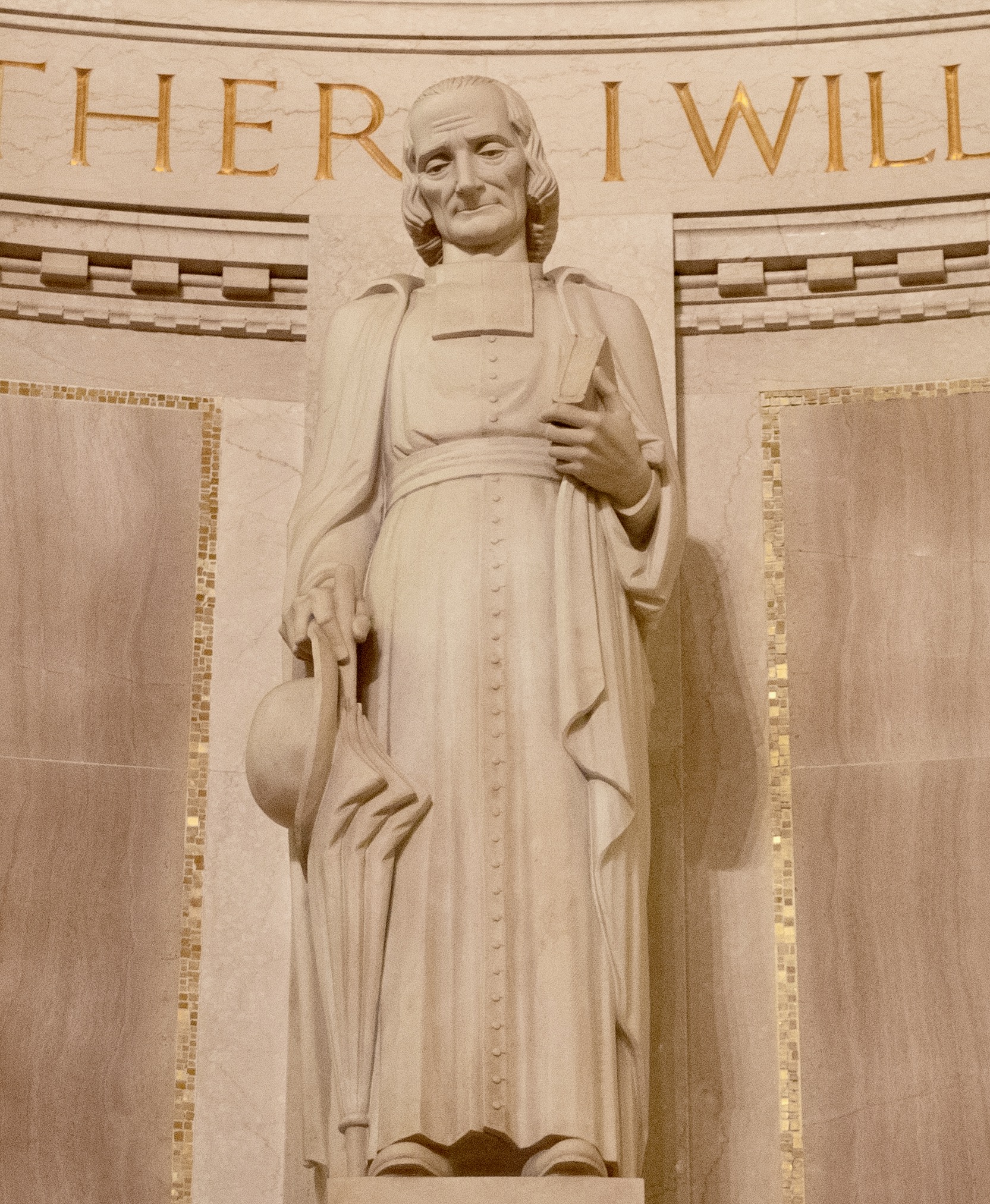
John Vianney was born to a shepherd-farmer in France in 1786, shortly before the beginning of the Napoleonic Revolution. As a young man, he wanted to pursue ministry, but scarcely had he begun his studies with Abbé Balley when he was drafted into the army. After falling ill when his battalion was leaving for Spain and staying behind, he lived in hiding with a group of deserters until Napoleon declared general amnesty in 1810.
Once he could resume his studies with peace of mind, Vianney enrolled in the seminary at Lyons. He struggled greatly with Latin – which was unfortunately the language all his classes were conducted in. And although he failed his exams for the priesthood, his personal devotion was so great that Abbé Balley intervened on his behalf, tutoring him privately until he was ordained in 1815.
Vianney was next sent to work at a rural village called Ars, where he gained such great popularity that people traveled from far and wide to come visit him. In the last 15 years of his life, he spent 12 to 16 hours a day in the confessional and received 300 visitors a day on average. A special train ticket was sold in Lyons specifically for the pilgrimage to Vianney’s parish, and in the final year of his life, over 100,000 individuals came to visit him. He was so beloved among the French people that Napoleon sent him the Imperial Order of the Legion of Honor, but he refused to accept it. With a life so dedicated to ministry, Vianney’s own health suffered from overwork, and at age 73, he passed away. Today, he is known as the patron of parish priests.
Sources:
Butler’s Lives of Saints, ed. Bernard Bangley.
“St. Isidore of Seville,” Catholic Online.
“St. Isidore of Seville,” University of Notre Dame.
The Way of Saints, by Tom Cowan.