
Since 1946, 11 Americans have been canonized as saints.
Many were immigrants who crossed treacherous seas to spread the Gospel. Some, like John Neumann, had only a few dollars to their name; others, like Katharine Drexel, used their resources to further God’s kingdom. But these men and women all had two things in common: they loved the Lord, and they called America home.
This year, as we celebrate the 250th birthday of the United States of America, we invite you to explore the stories of American saints honored in the Basilica. In this second installment, you can read about St. Katharine Drexel, St. Junípero Serra, and St. Théodore Guérin.
This post is Part II in a series. Read Part I.
St. Katharine Drexel
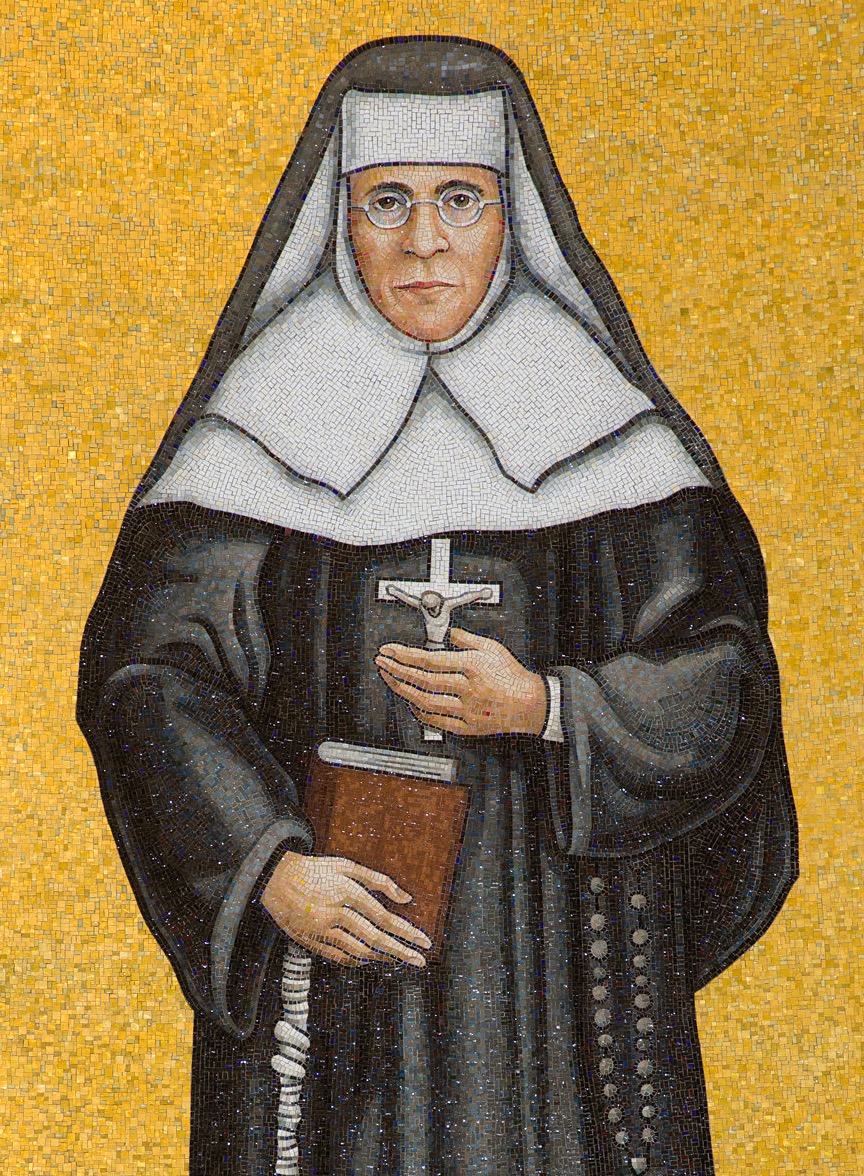
Born into an affluent Philadelphia banking family in 1858, St. Katharine Drexel was known for her commitment to racial justice and her educational efforts for minority groups in America. During her family’s travels across the western United States, Katharine was struck by the poor living conditions endured by Native Americans on reservations. Seeking to help, she became an unflagging advocate for minorities, crusading for better educational opportunities and standing against racial discrimination and injustice. In 1894, she opened the first mission school for Native Americans in New Mexico, and in 1915, she founded Xavier University, an institution of higher learning for African Americans in New Orleans. She also decided to use her inheritance to establish the Sisters of the Blessed Sacrament, which was approved by the pope in 1913.
By the start of World War II, she had founded schools for African Americans in 13 states, and 50 schools for Native Americans in 16 states. Katharine lived to be 97, and in 2000, was the second American-born saint to be canonized. The patroness of racial justice and philanthropists, she is portrayed in the Hall of American Saints, the Trinity Dome, and the Crypt Church Sacristy.
St. Junípero Serra
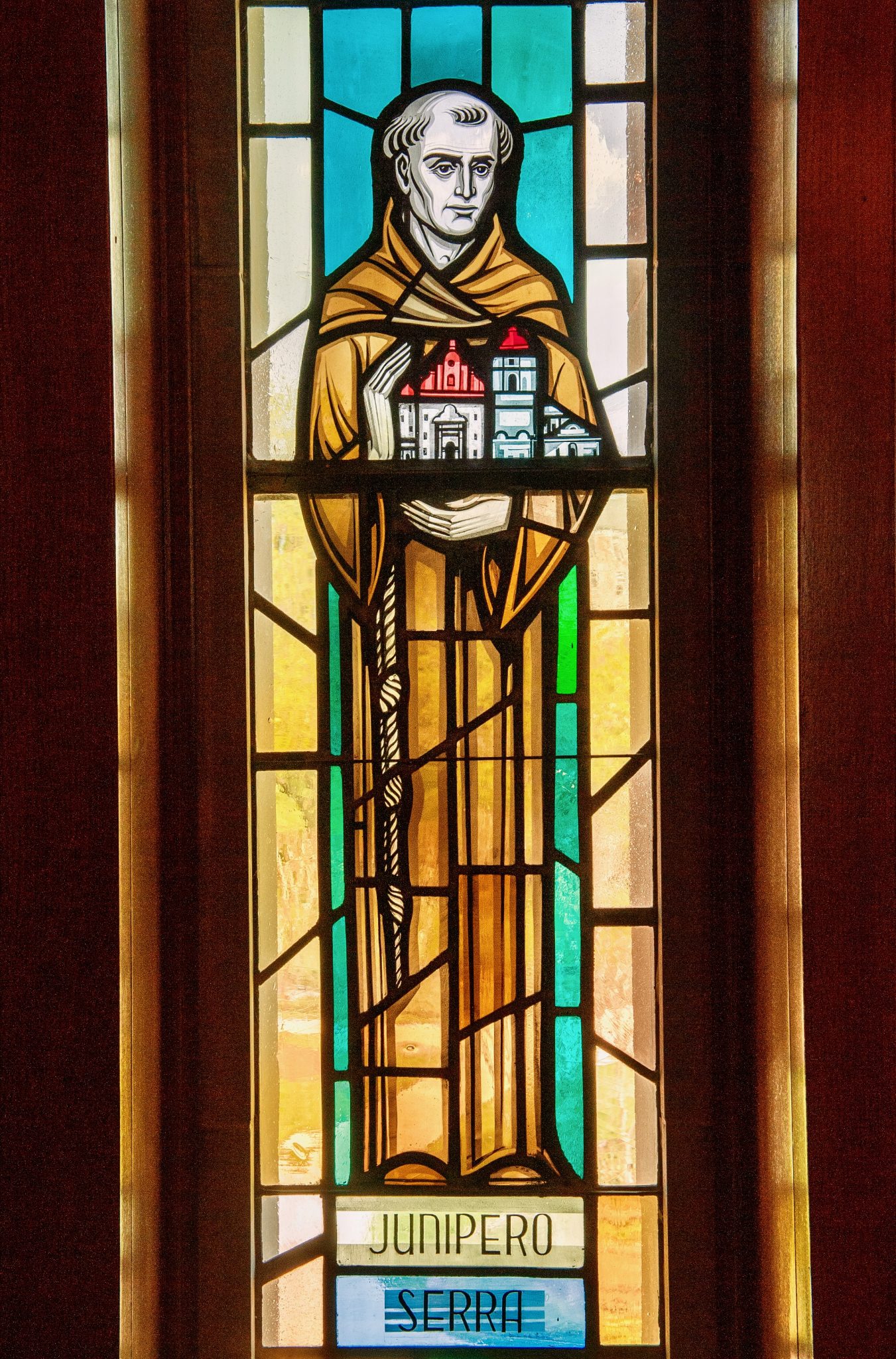
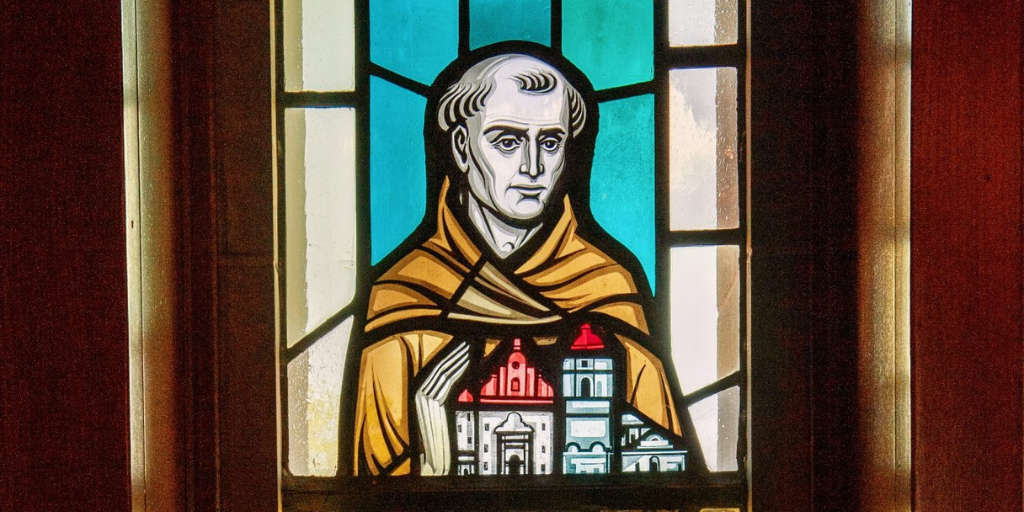
Did you know that St. Junípero Serra’s canonization was the first to take place on U.S. soil? Presided over by Pope Francis on September 23, 2015, it was also the first canonization ever to take place at the Basilica.
Known as “the Apostle to California,” Junípero Serra was instrumental in introducing the Gospel to the Americas. Born in Petra, Majorca, Spain in 1713, he joined the Franciscan order at the age of 16 and earned his doctorate at Lullian University before coming to America in 1749. He often defended Indigenous people from government overreach, and was known for teaching both religious truths and agricultural skills with care and passion. He even learned one of the Native American languages in order to share the Gospel more effectively, and founded a total of nine missions across California.
It is estimated that over the course of his ministry, Junípero Serra baptized over 6,700 Indigenous people and confirmed over 4,500. Despite suffering from a variety of medical conditions that often made traveling extremely uncomfortable, he made many long journeys on foot. During one trip, he walked a total of 1,700 miles! At the age of 70, Serra passed away at Mission San Carlos, where he was also buried.
St. Théodore Guérin
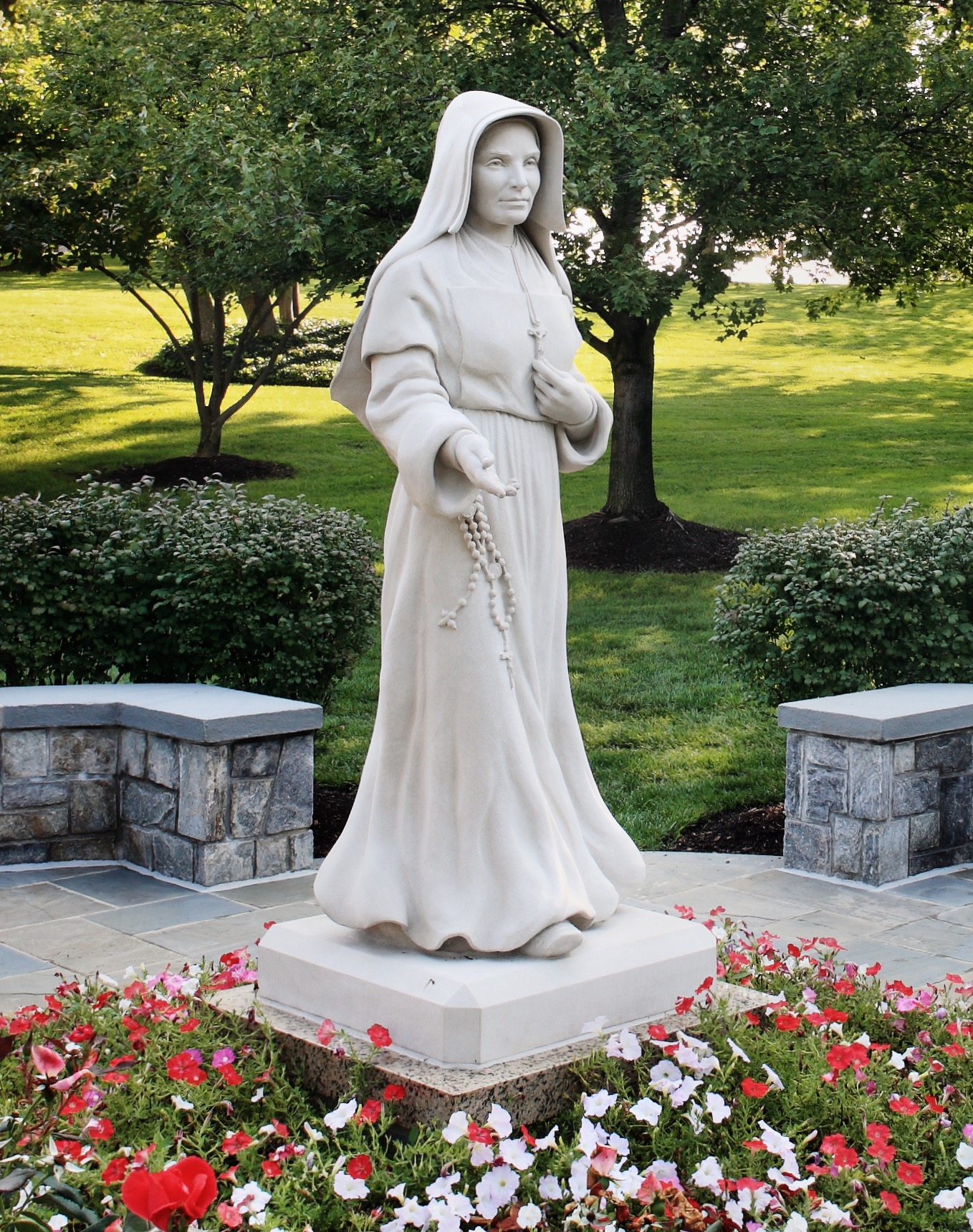
St. Théodore Guérin was born as Anne-Thérèse on October 2, 1798, in the town of Estables, France. The girl was devout from a young age, and at age 10, she told a parish priest that she intended to be a nun. When Anne-Thérèse was only 15, her father was murdered by bandits, leaving her to care for her mother and sister. In the face of personal tragedy and difficulty, Anne-Thérèse turned to God for solace.
At age 25, she joined the Sisters of Providence of Ruillé-sur-Loir, a religious order focused on caring for the sick and impoverished, as well as furthering children’s educational opportunities. There, she became known as Théodore, and was asked to take a group of women on a mission to Indiana to minister to pioneers.
In Indiana, Théodore founded the order of the Sisters of Providence of Saint Mary-of-the-Woods, establishing a motherhouse and a school. They faced untold trials in Indiana – from starvation and bitter winters to prejudice against Catholics. Throughout everything, however, she relied solely on God, telling her sisters, “Put yourself gently into the hands of Providence.” Théodore went on to establish two orphanages and more schools in the region, and eventually passed away on May 14, 1856. She is portrayed at the Basilica in a life-size limestone statue adjacent to Mary’s Garden and honored in a tablet in Memorial Hall.
Sources:
Butler’s Lives of the Saints, ed. by Bernard Bangley.
“Katharine Drexel,” Britannica.
“Katharine Drexel (1858-1955),” The Vatican.
Rohling, Geraldine M., PhD, MAEd. The Basilica of the National Shrine of the Immaculate Conception: Guide and Tour Book. Washington, D.C.: Basilica of the National Shrine of the Immaculate Conception, 2018.
“Saint Junípero Serra,” USCCB.
“The Cause of Junípero Serra,” Dr. Geraldine Rohling.
“Théodore Guérin,” The Vatican.