This month, we’re delighted to share the seventh post in our Walk Through Art blog series, highlighting the sacred art of the Basilica as it corresponds to important Church celebrations and moments in the life of the National Shrine. In this post, we invite you to discover four art pieces we’re highlighting this March – from the Perpetua and Felicity Chapel to the St. Joseph the Worker mosaic!
March 7 – The Saints Perpetua and Felicity Chapel
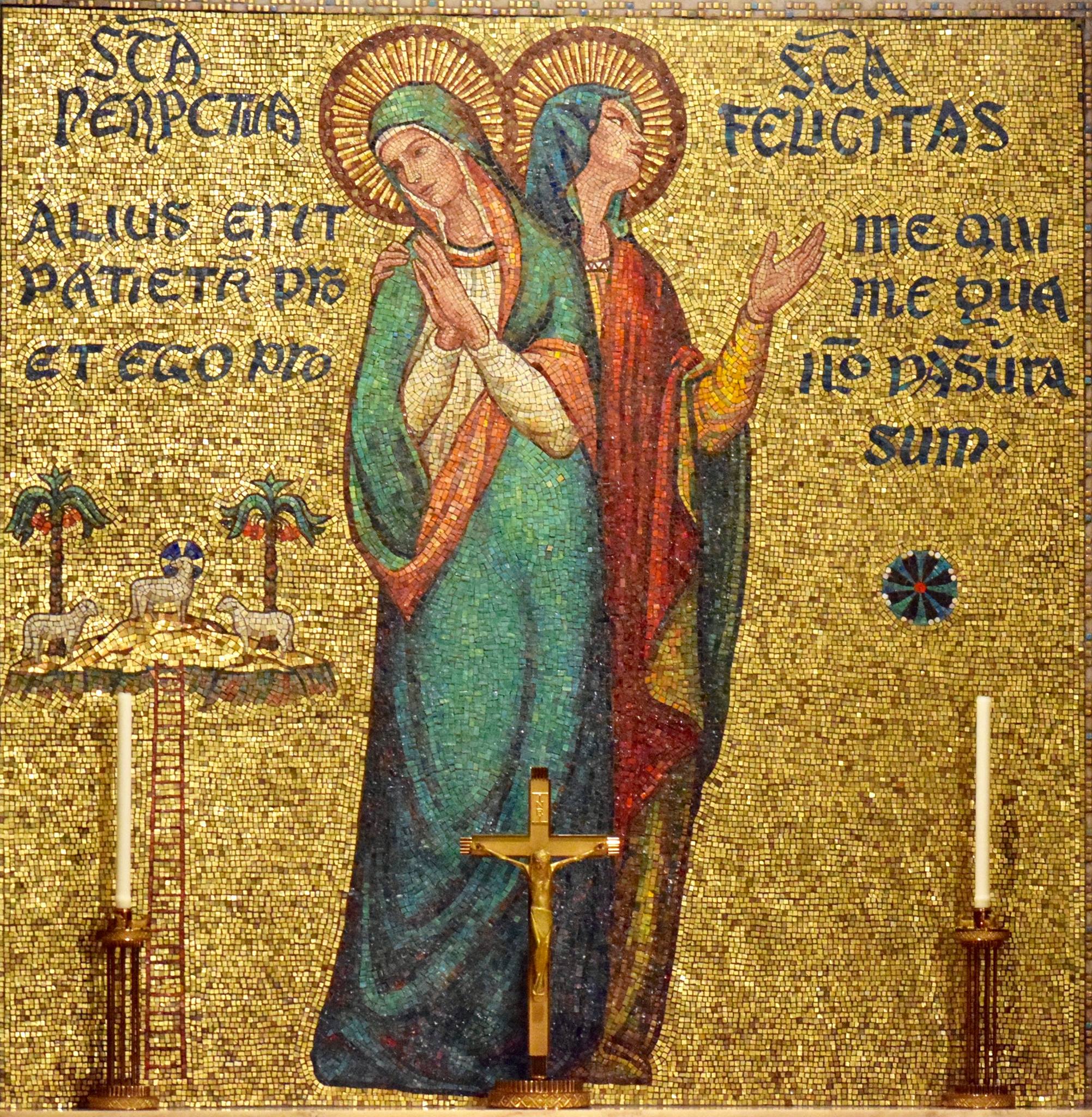
Celebrated on March 7, Saints Perpetua and Felicity were martyred for their faith in Carthage in A.D. 203 under the reign of the emperor Severus. At the Basilica, the Saints Perpetua and Felicity Chapel in the Crypt Church honors these women in glittering gold mosaic. Flanked by a flower and ladder, the two women are depicted in rich jewel-toned robes, journeying toward an oasis. The Latin text in the chapel features the words spoken by Felicity at the birth of her last son, which translates: “Another will be within me, who will suffer on my behalf, seeing that it is for Him that I am to suffer.” All seven of her sons are depicted in silhouette on the altar frontal alongside a sword, representing Perpetua and Felicity’s martyrdom.
 March 17 – The Mary, Queen of Ireland Oratory
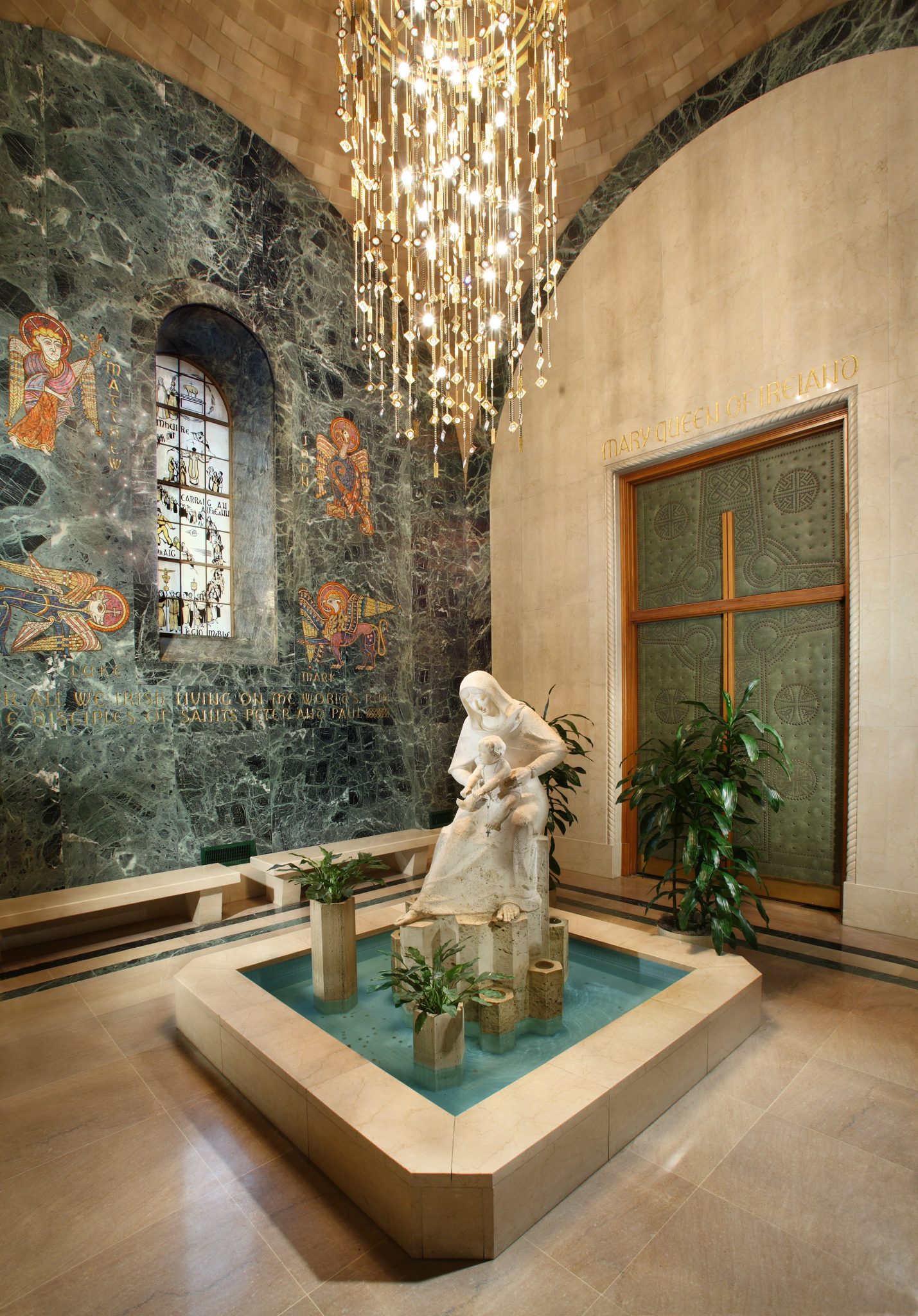
With the celebration of St. Patrick’s Day on March 17, we invite you to explore how Irish Catholic heritage is honored in the Mary, Queen of Ireland Oratory. In the center of the oratory stands a statue of Our Lady and the Holy Child, with Mary holding Jesus tenderly on her knee. The hexagonal rock formation on which the statue is placed represents the Giant’s Causeway, an area in Northern Ireland where volcanic activity created a pattern of basalt columns on the coast of the sea.
Amidst the deep greens pervading the oratory are symbols of the heritage of the Emerald Isle. A quote from St. Columban of Bobbio ornaments the south wall, as well as mosaic depictions of the four evangelists as found in the classic Irish masterwork, the Book of Kells. On the north wall is a map of Ireland and a depiction of St. Patrick.
March 19 – The St. Joseph, the Defender of the Church and Patron of Workers Mosaic
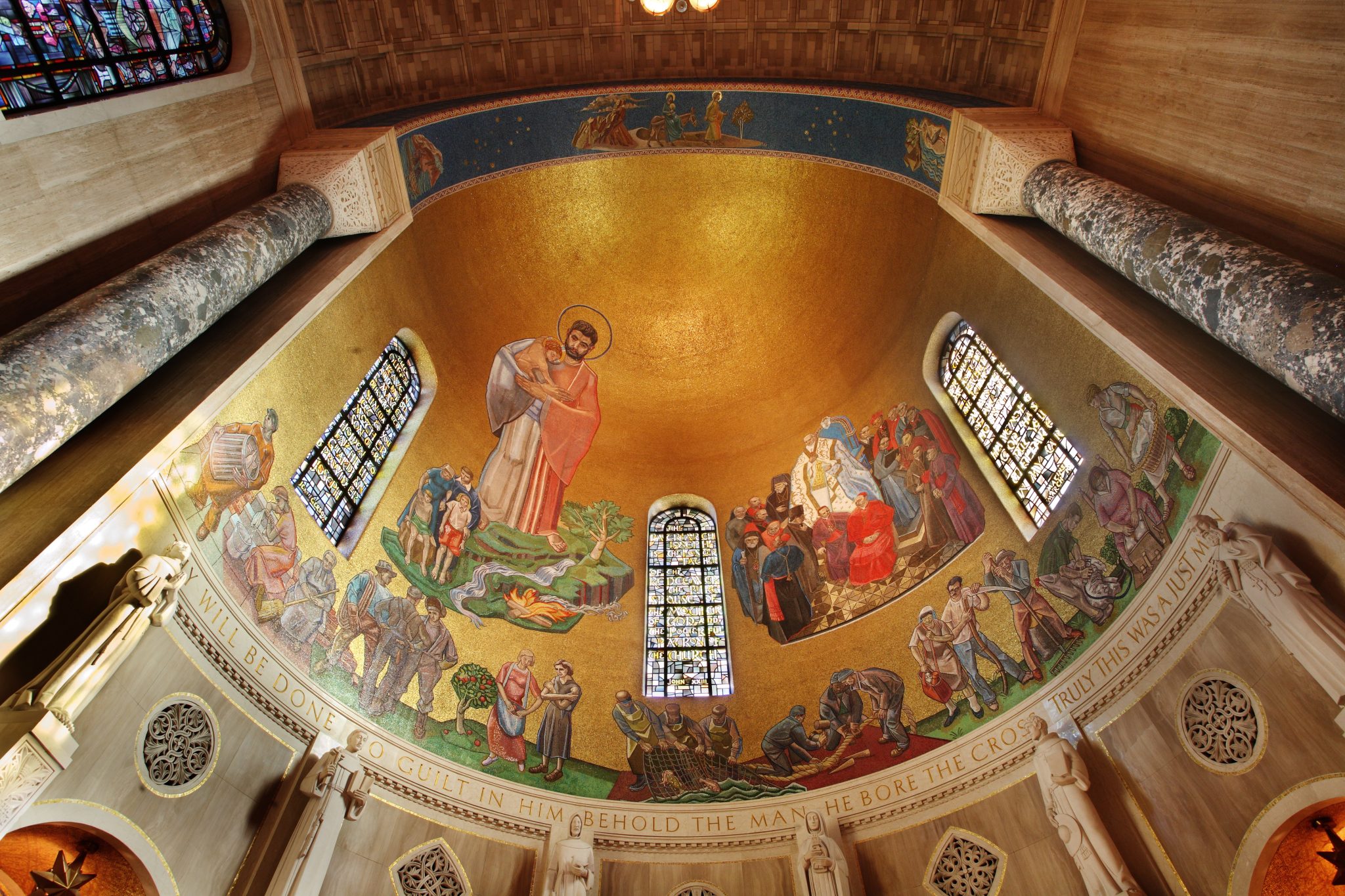 On March 19, we celebrate the Feast of St. Joseph, the earthly father of Jesus and the patron of the Universal Church. Though Joseph is only mentioned a few times in the Bible, the gospel accounts, especially Matthew’s Gospel, demonstrate his upright character and strength as the leader of his family. Joseph played an important role in Jesus’ early life, serving as a strong earthly father and protecting Jesus and Mary.
While Joseph was a carpenter by trade, he was of noble lineage — a descendant of King David himself. This regal nature is conveyed in the mosaic of the East Apse of the Great Upper Church, Saint Joseph, the Defender of the Church and Patron of Workers. In this stunning portrayal, St. Joseph towers over the viewer, holding the Christ Child. He is surrounded by Egyptian motifs, including pyramids, the Nile River, a palm tree, and an ibis, calling to mind the Holy Family’s flight into Egypt, which is depicted in the soffit mosaic above. Because St. Joseph was named the protector and guardian of the Second Vatican Council, the right side of the mosaic features depictions of its participants and Pope John XXIII.
 March 25 – The Annunciation Chapel
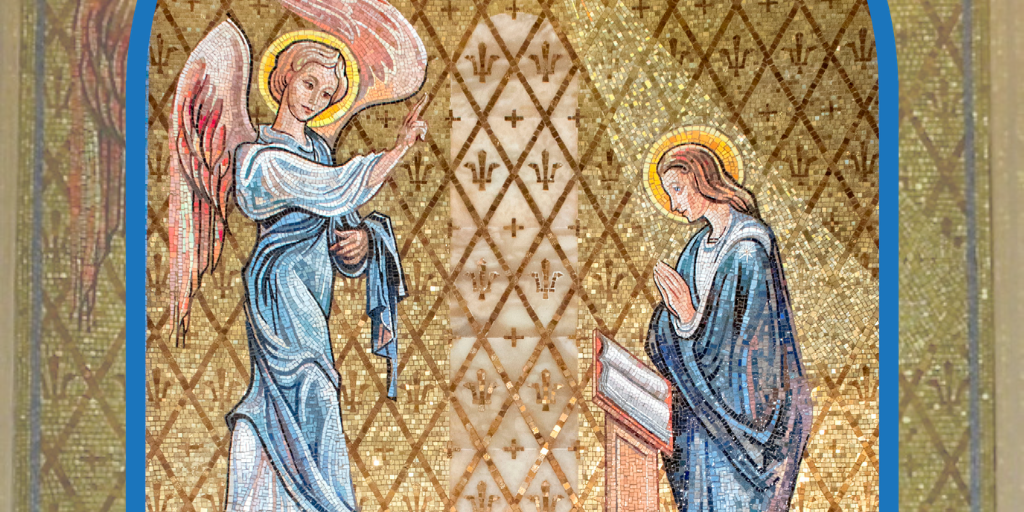
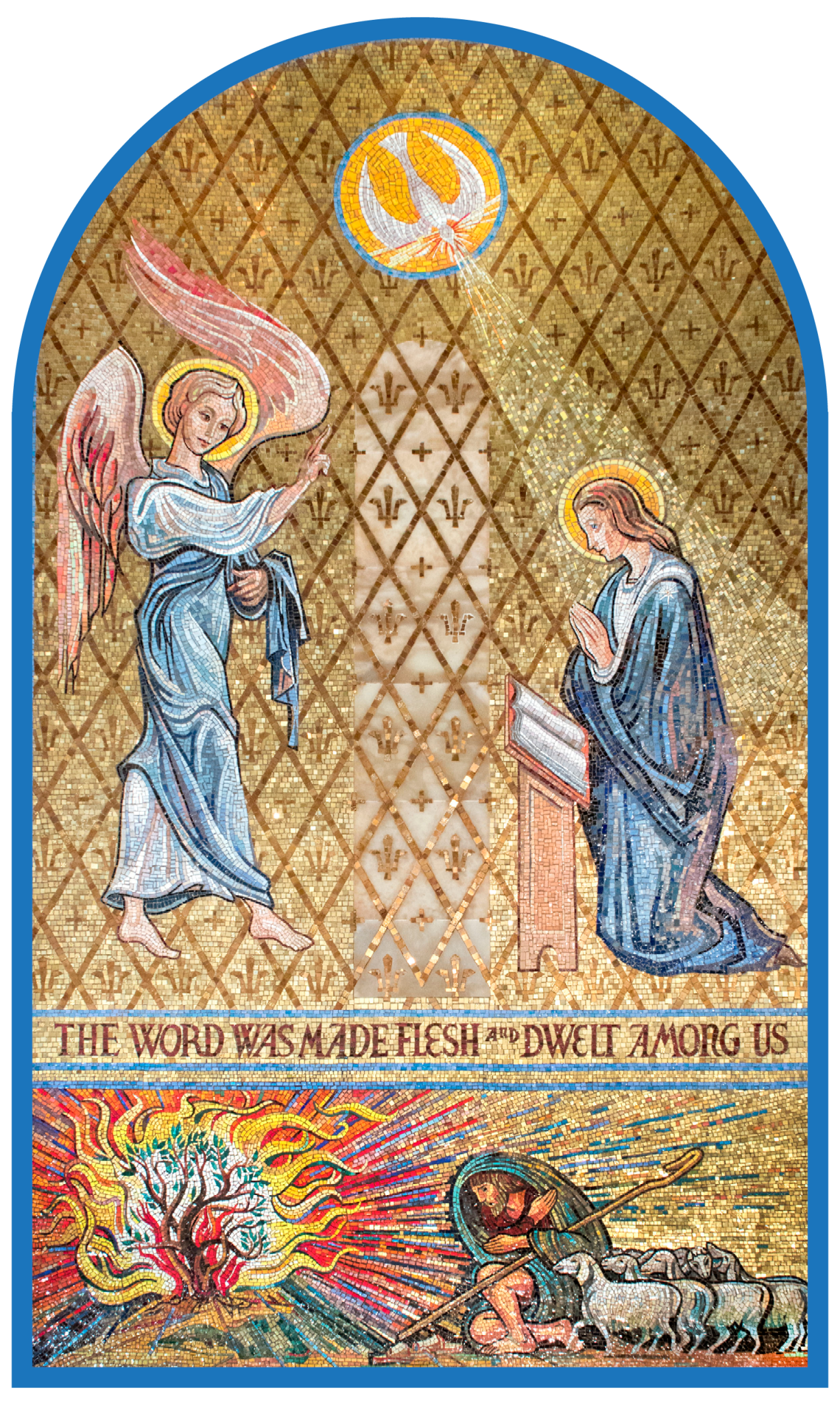
On March 25, we celebrate the Solemnity of the Annunciation, when the angel announced to Mary that she would bear the Savior of the World. In the Great Upper Church, you can find this joyful mystery portrayed in shimmering gold mosaic in the Annunciation Chapel. Here, Mary and the angel Gabriel appear in gentle shades of blue and pink, while the Holy Spirit, represented by a dove, radiates a luminous beam from above.
The serene softness of the upper portion of the mosaic finds a radical contrast in the lower portion, which portrays the Old Testament parallel of Moses and the burning bush. From the bush, the unfathomable power of God is evoked in a burst of electric hues, while Moses hides his face. The text in the chapel reads, “The Word was made flesh and dwelt among us,” from John 1:14, highlighting how God came to save us just as He called Moses to save the Israelites.
Source:
Rohling, Geraldine M., PhD, MAEd. The Basilica of the National Shrine of the Immaculate Conception: Guide and Tour Book. Washington, D.C.: Basilica of the National Shrine of the Immaculate Conception, 2018.