
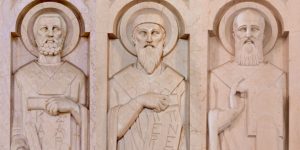
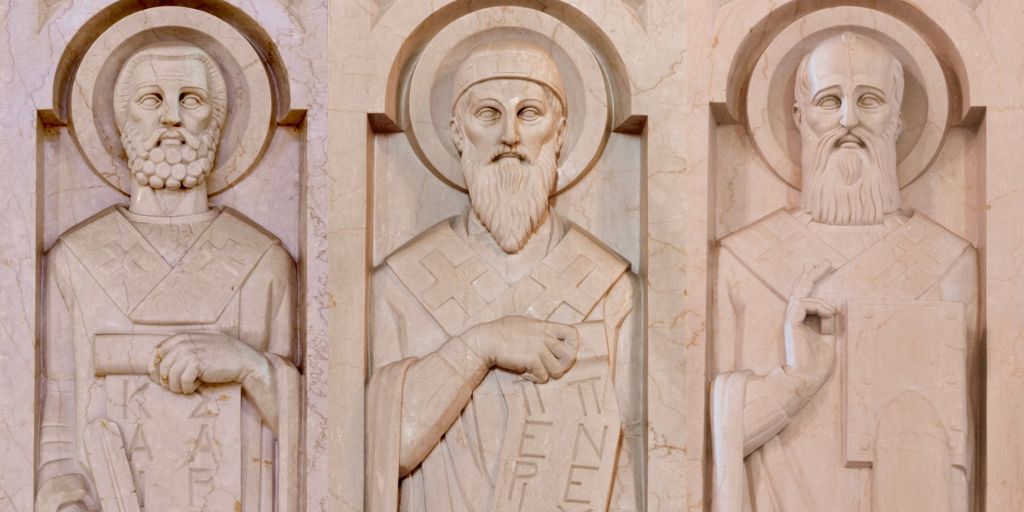
Standing over 40 feet above the Immaculate Conception Altar, the sanctuary baldachin is hard to miss. But what some visitors might not know is that each of its corners depict different Church Fathers in relief sculpture. These saints played a key role in shaping doctrine in the Early Church, whether they were battling heresy, translating the Scriptures, or providing much-needed leadership.
In this first post in our Saints of the Baldachin series, we invite you to discover the stories of the four Eastern Church Fathers portrayed on the east side of the baldachin and learn about the symbolism of their depictions.
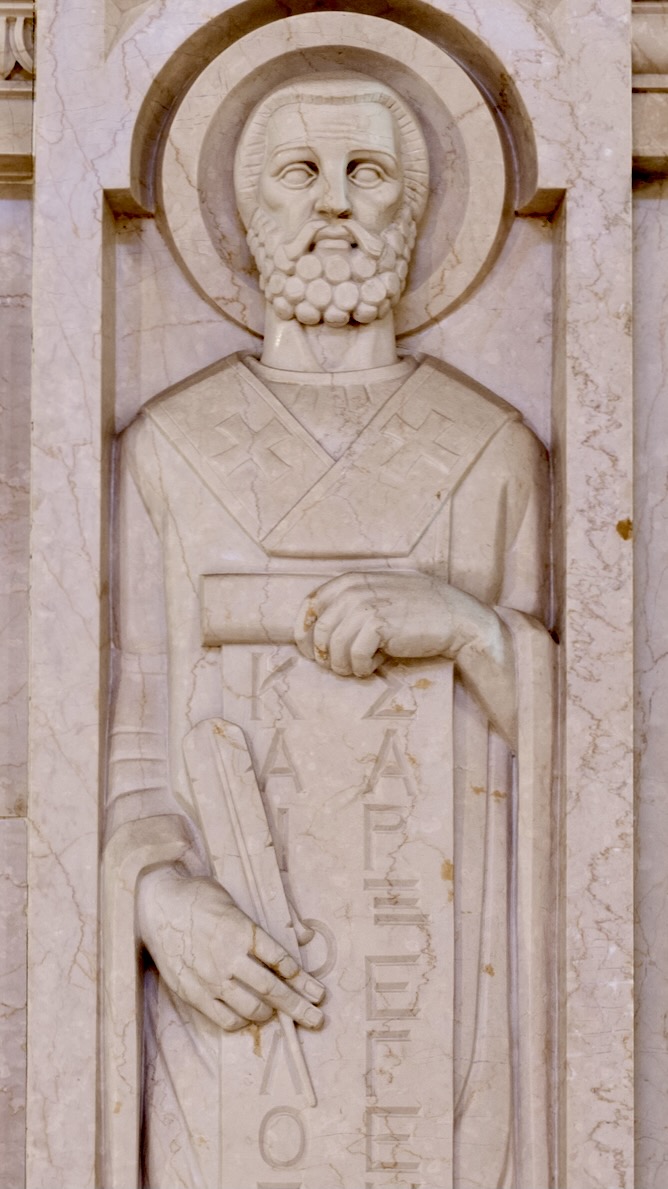 1. St. Athanasius
Born around 296 in Alexandria, Athanasius received an education in Christian doctrine and began working for a prominent bishop in 318. Shortly after, he found himself at the forefront of the debates over the Arian heresy, which claimed that Christ was not fully God. In response, the Church formulated the Nicene Creed and condemned the heresy’s promulgator with an encyclical letter possibly written by Athanasius himself.
After assuming the role of bishop of Alexandria in 328, Athanasius ardently defended the fundamentals of the Nicene Creed and soon found himself assailed by lawsuits, harassment, and more. At one point, after being ambushed by troops amidst a church vigil, Athanasius fled Alexandria and spent six years in hiding. During this time, he produced some of his most significant works, including a biography of St. Anthony and polemics against Arianism. Over the course of his ministry, he also created the first list of books to be included in the Christian Bible, and his selection was later confirmed as canon by St. Jerome. In the baldachin, he is portrayed holding a quill and a scroll with John 1:14, “And the Word was made flesh,” written in Greek, signifying him as the theologian of the Incarnation.
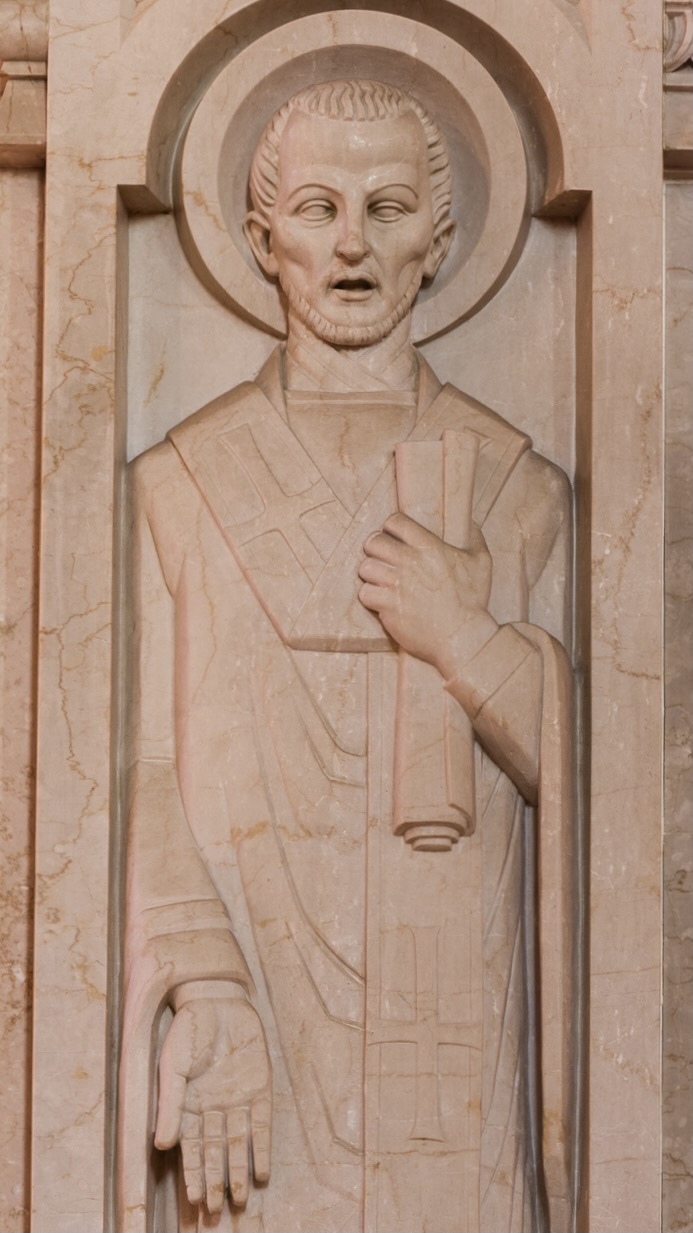 2. St. John Chrysostom
The son of an army officer, John was born in Antioch, Syria, in 347, and became a Christian at age 23. Upon his conversion, he went to live with some monks in the mountains until poor health forced him to return to the city. After becoming the bishop of Constantinople in 397, he began to gain notoriety for his preaching.
Many of John’s sermons criticized the sensuous and lavish lifestyles led by the wealthy while the poor languished in the slums. His fearless excoriation of aristocratic customs eventually resulted in his exile to a remote town on the Black Sea. Unfortunately, he was forced to make the journey on foot in the middle of a blazing summer, pushed onward at an impossible pace by inhumane guards. Just a few months later, he was carried to a nearby chapel, where he died of exhaustion. His last words were, “Glory be to God for all things.” In the baldachin, he is portrayed holding a rolled manuscript, symbolizing his homilies.
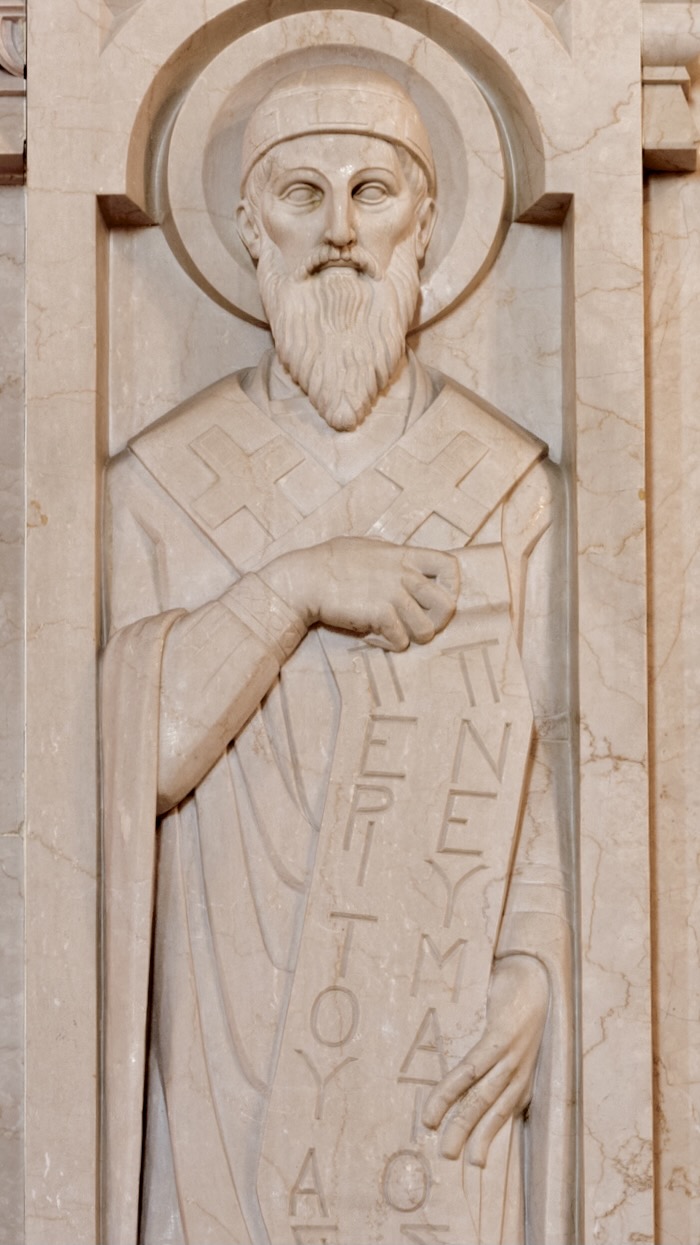 3. St. Basil
Born in 329 in Caesarea, Basil lived when disagreements about Arianism were pervasive and divisive. Basil was baptized at age 29, and in the years that followed, he lived as a hermit and eventually became the archbishop of Caesarea. But his opposition to Arianism resulted in challenges to his authority even from the secular world; at one point, the Arian emperor Valens split Basil’s region into two dioceses to undermine his authority.
Despite the opposition he faced, Basil led with compassion, distinguishing himself as a moving orator and writer, and directing his attention both to the spiritual and temporal needs of his region. He preached as often as twice a day, cared for the needy, provided support during a famine, fought prostitution, and even built a hospital. He was also a prolific writer, penning many letters and books to defend the Church’s doctrine. In the baldachin, he is portrayed with an open scroll featuring the title of one of his books in Greek: Concerning the Holy Spirit.
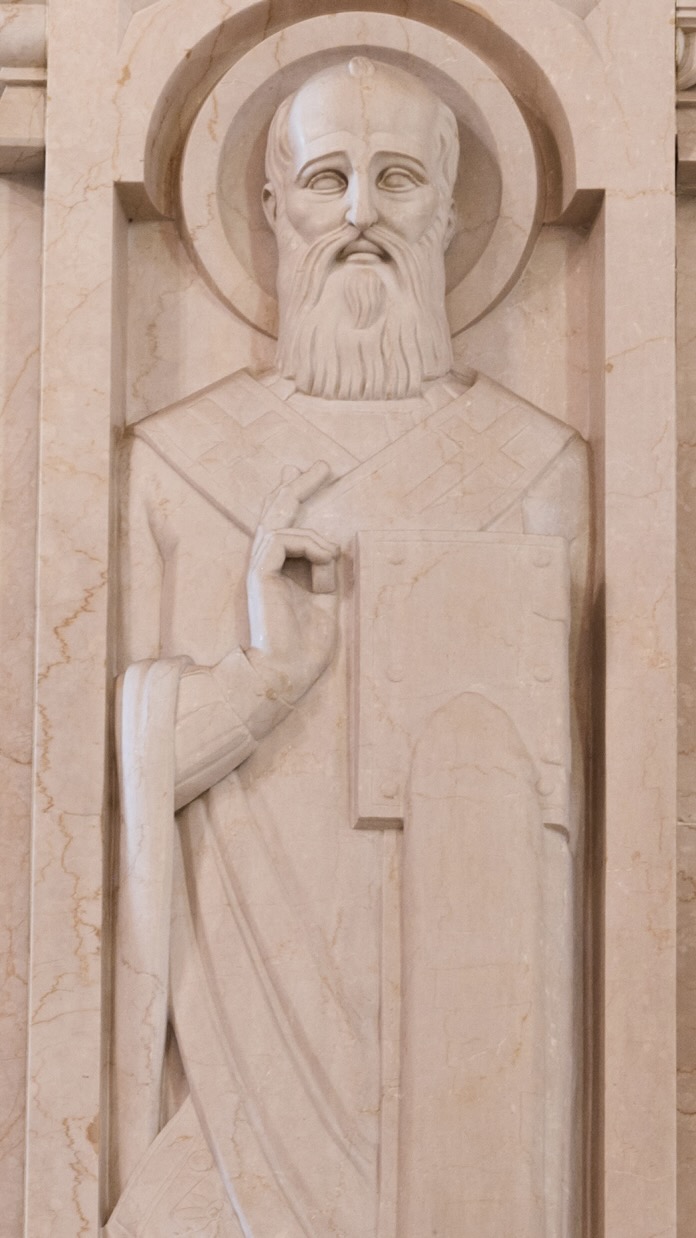 4. St. Gregory Nazianzen
Born around the year 325, Gregory passionately defended the doctrine of the Trinity during a critical period for the Church. Gregory was baptized at age 30 and studied with his brother in Caesarea, where he met St. Basil. Over the years, Gregory assisted Basil in a number of efforts, including his battles against Arianism and his clashes with the Arian Emperor Valens. Unfortunately, Gregory’s desire to help Basil would ultimately culminate in the breaking of their friendship. When Basil established a See at Sasima, he consecrated a reluctant Gregory as its first bishop. But Gregory soon found himself as ill-suited to the position as he had predicted, and left to serve his father in Nazianzus.
Following the death of Emperor Valens, Arianism no longer received imperial support, leaving greater opportunity for combatting the heresy. Despite his reservations, Gregory went to restore truth in the city of Constantinople in 379, preaching on the doctrine of the Trinity at his Chapel of the Resurrection. These profound sermons would eventually become some of his most well-known works. Eventually, he returned home to Nazianzen, where he lived peacefully, composing many poems in the final years of his life. In the baldachin, he is portrayed carrying a book of the Liturgy.