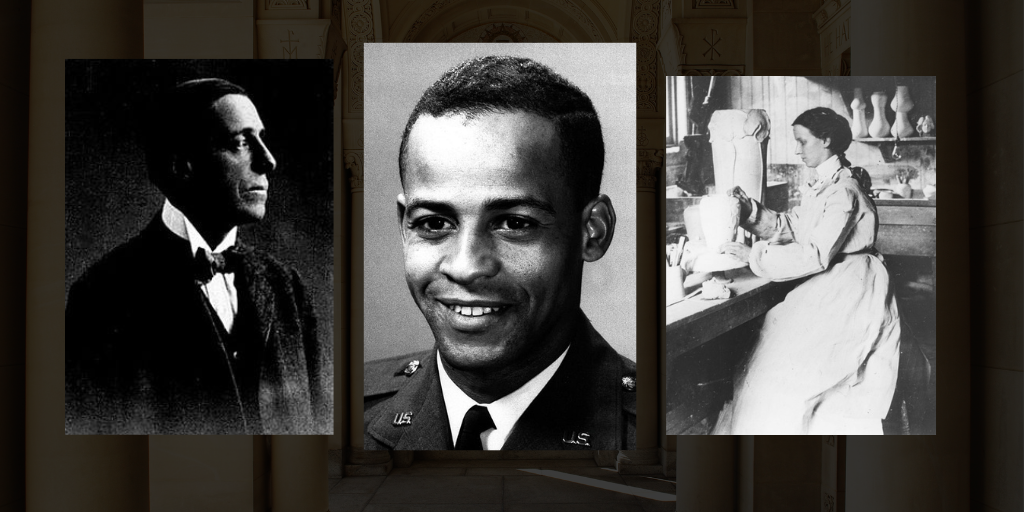
Did you know that over 100 artists and designers have created art for the National Shrine? Spanning a diverse range of styles, eras, and traditions, the artistic ornamentation of the Basilica reflects the diverse heritage of the United States through mosaics, sculptures, and more.
This year, as we celebrate the 250th birthday of the United States of America, we invite you to explore the stories of three American artists whose work is featured at the Basilica.
Mary Chase Perry Stratton
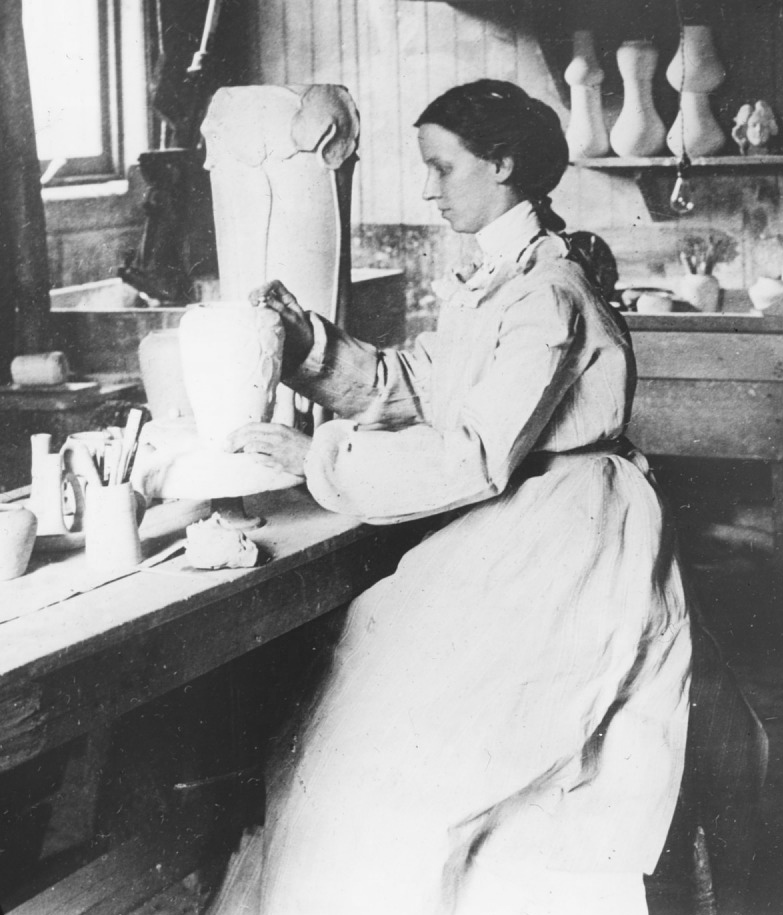
Born in Hancock, Michigan, in 1867, Mary Chase Perry Stratton chiefly studied at the Art Academy of Cincinnati. Following her education, she started her own china painting business in Asheville, North Carolina, in 1891, and in 1896, she was enlisted by Horace J. Caulkins to help sell his new “Revelation” kilns. Her work for Caulkins vastly increased her visibility, enabling her to travel for demonstrations throughout America, expanding her professional network, and opening up new opportunities with china painting magazines and ceramic art organizations.
The next chapter of Mary’s life brought exciting developments both personally and professionally. Not only did she marry her colleague, William Stratton, but she made a foray into pottery and opened a studio. Thanks to the support of Caulkins, she also had the freedom to experiment with firing and glazing methods, which in turn allowed her to develop her signature style. As the years went by, she chose the name “Pewabic Pottery” for the studio, which gained a reputation for its exhibitions and orders.
The largest installation completed by Mary’s Pewabic studio was for the National Shrine. For this, she embarked on a trip to Europe in 1924 to study the sacred art in churches and chapels there, carrying home much inspiration for America’s Catholic Church. Today, you can find her work interspersed throughout the Crypt Church, where her signature tiling and glazing techniques bring the depictions of saints and scriptural figures to life. Best known for her development of iridescent glazes, she was a recipient of the Charles Fergus Binns Medal, “the highest award in the field of American ceramics.”
John Louis Bancel LaFarge
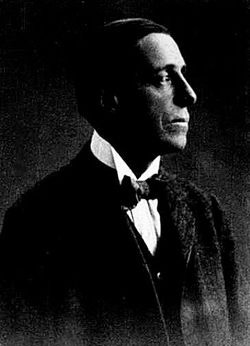
The grandson of French immigrants, John Louis Bancel LaFarge was born into an affluent family in Newport, Rhode Island in 1865. Growing up, Bancel showed great artistic promise and began working with his father at his art studio. In 1898, he married a fellow artist named Mabel Hooper, and in the years that followed, the couple moved to Paris so Bancel could perfect his painting and drawing skills. As he grew as an artist, he developed a fondness for Byzantine mosaics, as well as a passion for nature, which he imbued in his work.
By the early 1920s, Bancel LaFarge had made a name for himself as a skilled muralist and Byzantine mosaicist. So when the National Shrine sought an artist to design the 15 mosaic reredoses (ornamental walls) for the altars in the Crypt Church, Bancel LaFarge was the obvious choice. To bring the mosaics to life, Bancel used a variety of historic techniques which reflected the style of the famous mosaics of Palermo, San Marco, and Santa Maria Maggiore.
After completing his work for the National Shrine, Bancel became involved in a variety of independent projects and worked with his son on art initiatives funded by President Roosevelt’s New Deal programs. In 1938, Bancel’s health began to decline, and he passed away on August 15 at the age of 72. Today, Bancel’s breathtaking designs are viewed by hundreds of thousands of pilgrims each year, inspiring the faithful to reflect on the lives of the saints who have gone before us.
Ed Dwight
Judging from Ed Dwight’s smashing success as a sculptor, you’d never guess that art wasn’t his first profession. With 129 monuments and 18,000 gallery pieces under his belt, Ed Dwight has become the definitive sculptor of our age for representing the Black experience in America. But despite his early interest in art, he began his career not as a sculptor, but as an engineer and pilot. After earning an associate’s degree in engineering from Kansas City Junior College, he joined the Air Force in 1953. During his time there, he completed an aeronautical engineering degree at Arizona State University, logged over 9,000 flight hours, and flew some of the most advanced aircraft of the time.
In recognition of his exceptional talents, Ed was invited to attend the Aerospace Research Pilot School, where he underwent elite training to become a candidate for NASA. There, he faced hostility as the only African American in the program. He was later one of 26 potential astronauts recommended to NASA, but in a move that remains embroiled in controversy to this day, he ultimately wasn’t selected to join the space program. Though he’d missed the chance to become the first Black man to go into space, he still had made a groundbreaking achievement by becoming the first Black astronaut candidate.
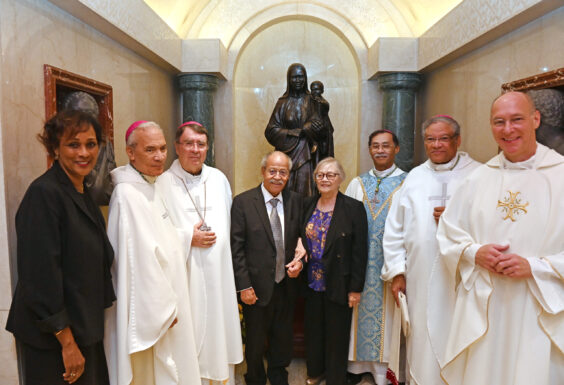
After Ed retired from the Air Force in 1966, he created sculptures in his spare time, but thought of art as little more than a hobby until he was commissioned to create a sculpture for the Colorado Capitol. It was this first step that set him on a new journey: telling the story of the African American experience through art. In 1977, he obtained his Master of Fine Arts in Sculpture from the University of Denver, and in the years that followed, his art career flourished. His sculptures sell to private buyers for as much as $100,000, while his monuments can cost millions. Here at the Basilica, Ed Dwight’s bronze sculpture “Our Mother of Africa and Her Divine Son” is the focal point of the Our Mother of Africa Chapel. Today, he lives in Denver, where he runs an art studio from a converted 30,000 square ft. aircraft carrier.
Sources:
“Bancel La Farge, Artist, Is Dead,” The New York Times.
“Ed Dwight, America’s first Black astronaut candidate, becomes oldest person to reach space,” NBC News.
“Ed Dwight Was Going to Be the First African American in Space. Until He Wasn’t,” Smithsonian Magazine.
“Ed Dwight Was Set to Be the First Black Astronaut. Here’s Why That Never Happened,” The New York Times.
“Ed Dwight was to be the first Black astronaut. At 90, he’s finally getting his due,” Associated Press.
“From Almost-Astronaut to Businessman to Sculptor: Ed Dwight’s Incredible Journey Runs Through DU,” Denver University.
Historic Timeline from the William and Mary Stratton House.
“How the first Black astronaut candidate became a prolific Denver sculptor,” Denver 7.
“John La Farge: Biography,” Boston College Libraries.
“LaFarge, Bancel,” Connecticut State Library.
“Louis Bancel La Farge,” Monuments Men and Women Foundation.
“Mary Chase Perry and the Origins of Pewabic Pottery,” The Henry Ford Museum of American Innovation.
“Mary Chase Perry Stratton,” National Parks Service.
Rohling, Geraldine M., PhD, MAEd. The Basilica of the National Shrine of the Immaculate Conception: Guide and Tour Book. Washington, D.C.: Basilica of the National Shrine of the Immaculate Conception, 2018.
Rohling. Jubilee 2009: A Photographic History of the Basilica of the National Shrine of the Immaculate Conception.
Historic images accessed at Wikimedia Commons and the Basilica Archives unless otherwise indicated.