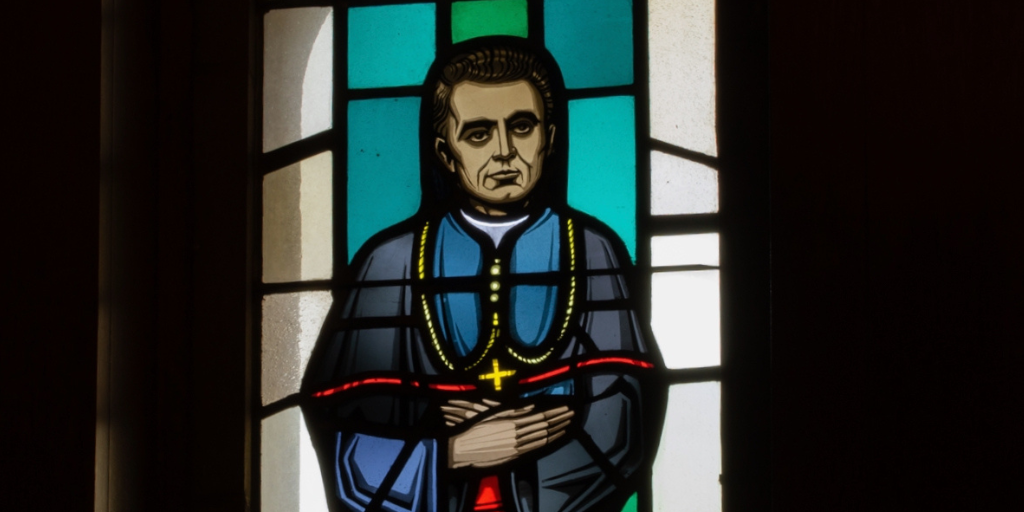
For James Augustine Healy, the path to the priesthood wasn’t easy. As a mixed-race American in the 1800s, he faced obstacles everywhere; he was considered illegitimate, denied educational opportunities, and almost prevented from being ordained. Yet through the grace of God, he not only completed a seminary education, but made history by becoming the first African American to serve as a Catholic bishop!
As we honor the anniversary of James Augustine Healy’s passing on August 5, we invite you to learn more about his life, legacy, and where you can find him portrayed in the Basilica.
James Augustine Healy’s Early Life

Born on a Georgia plantation on April 6, 1830, James Augustine Healy was the son of a half-Black slave woman named Eliza and an Irish immigrant named Michael. Though Michael called her his wife, a mixed-race marriage could not be legally recognized at the time, which meant that their 10 children were considered illegitimate and slaves. As such, they were prohibited from attending school, and did not receive any education until Michael took them north around 1837. Over the next few years, James and his brothers studied at schools in Long Island and New Jersey, but even still, they faced discrimination both for their Irish and African heritage.
The Healy Brothers Go to the Jesuit College of the Holy Cross
Thankfully, God had something much better in store for them. In the years that followed, Michael became friends with Bishop John Fitzpatrick of Boston, who would prove critical in shaping James’ career. It was at Fitzpatrick’s suggestion that the Healy boys transferred to the College of the Holy Cross in Massachusetts, where they were baptized. There, the brothers flourished and won academic distinction; in 1849, James served as valedictorian for the college’s first graduating class, and multiple Healy brothers were given awards for their academic performance. In reflecting on their time at the college, James said it was “entwined with the memory of the brightest and happiest days of our existence.”
Further Education and Career
James went on to study at the Sulpician Seminaries in Montreal and Paris, respectively, and was subsequently ordained a priest at the Cathedral of Notre Dame in 1854. Because of his race, he faced difficulties throughout his career, but found a tireless advocate in Bishop Fitzpatrick. It was Fitzpatrick who intervened when a requirement for James to prove his legitimacy almost prevented him from being ordained. And it was Fitzpatrick who secured James a place at the House of the Guardian Angel, where he cared for homeless boys and orphans. James also served as Fitzpatrick’s secretary for a time before he became chancellor of the Boston diocese.
Healy’s Tenure as Bishop

These early stages of James’ career were not without hardship; both his parents passed away during his time at seminary, and in 1866, Fitzpatrick passed away as well. But amidst these losses, new doors opened for James. That year, he was named pastor of St. James Church, the largest parish in Boston. There, he served for nearly a decade until he made history by becoming the first African American appointed as a Catholic bishop in 1875.
For 25 years, he guided the diocese of Portland, Maine, tirelessly devoting himself to spiritual care as masses of Irish and French-Canadian immigrants entered the region. His own Irish parentage – and fluency in French – likely helped him connect with these new communities, and during his tenure, the Catholic population of his diocese doubled! Under his leadership, 60 new churches, 68 missions, 18 convents, and 18 schools were established across the state.
Healy’s Heart of Compassion
Throughout all his work, James demonstrated a compassionate heart for the downtrodden, whether serving minorities, widows, orphans, or the homeless. He lobbied against child labor and anti-Catholic laws. And because of his advocacy for Indigenous Americans, Healy was made a consultant to the U.S. Bureau of Indian Affairs. In expressing his views on the inherent dignity of every person, he once remarked:
“We are of that Church where there is neither Gentile nor Jew, circumcision nor uncircumcision, barbarian nor Scythian, slave nor freeman, but Christ is all and in all.”
Healy’s Death and Legacy
Even as he served in positions of prominence, James chose to live humbly and simply. Rather than live in the bishop’s mansion, he chose to reside in the Cathedral Rectory. Before his death in 1900, he also requested to be laid to rest in South Portland’s Calvary Cemetery, rather than the Cathedral vault. Among his other honors and accomplishments, he was named assistant to the papal throne.
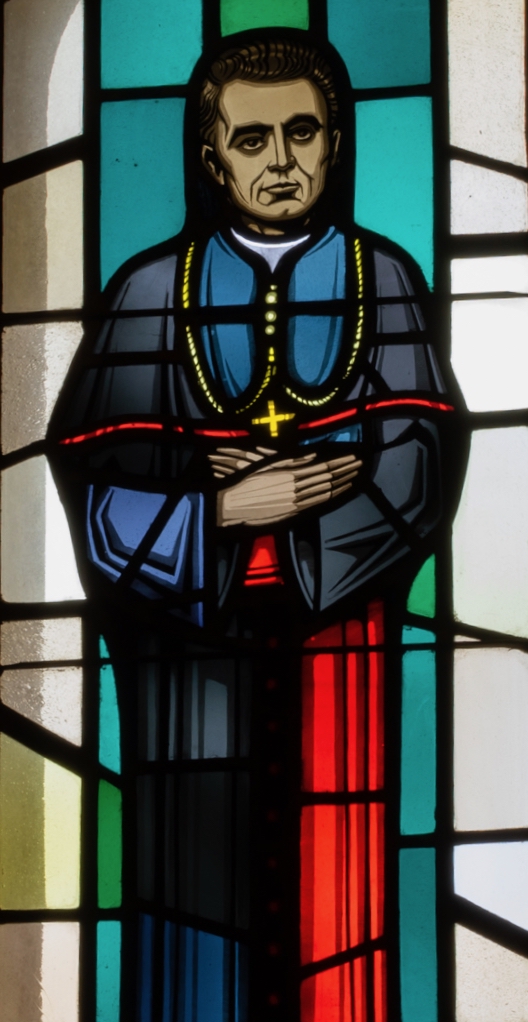
Today, Bishop Healy is remembered not only for his historic accomplishments as an African American Catholic, but for his steadfast commitment to serving the underprivileged. At the Basilica, you can find him portrayed in a sacristy window.
Sources:
“Holy Cross Honors Legacy of First African American Catholic Bishop,” Holy Cross Magazine.
“James Augustine Healy,” Britannica.
“James Augustine Healy: From slave to scholar to shepherd,” Roman Catholic Diocese of Portland.