
Known as the patron saint of Germany, St. Boniface played a significant role in the Christianization of its pagan regions. Bold in his witness and tireless in his ministry, he was unafraid to take a stand for the Gospel. As we celebrate his memorial on June 5, we invite you to discover five facts about his life and where you can find him portrayed in the Basilica.
1. He was an Anglo-Saxon monk.
While Christianity had become fairly widespread in Bavaria and the Rhinelands by the turn of the 700s, Germany still remained largely unevangelized. It was in 722 that Boniface set out to spread the Gospel to these unreached people.
2. His decision to fell an oak tree was a pivotal moment in winning the respect of the Germanic tribes.
Not long after Boniface’s arrival, there was a confrontation between Boniface and the Germanic tribes in the region where he preached. Pagan traditions honoring the Norse gods, such as the worship of trees, were still pervasive amongst these people. Determined to demonstrate their gods’ lack of power, Boniface felled an oak tree dedicated to the Norse god Thor. Much like Elijah removing the prophets of Baal on Mount Carmel, Boniface made a public spectacle of the act. Though the pagans watched in suspense, anticipating some great calamity to be meted out upon him, none followed. The lack of divine retribution gave them a new respect for him, and many converted. In an act that would illustrate the German people’s spiritual regeneration, Boniface took the wood from the oak tree and used it to build a church on the spot.
3. He was appointed bishop of all Germany in 747.
Boniface made considerable progress in his ministry, in part thanks to the support of Gaulish emperor Charles Martel. Even after Martel passed away, Boniface continued to receive royal endorsement for his work, and was appointed bishop of all Germany in 747. Throughout the 740s, Boniface accomplished significant reforms in the Christian communities in Gaul.
4. When Boniface entered his 70s, he returned to the German tribes to “reconvert” them.
As years passed, Boniface discovered that his work with the Germans was far from finished. Many of them still wanted to continue their pagan practices despite confessing a belief in Christ’s sacrifice. When Boniface entered his 70s, he returned to the German tribes to “reconvert” them, focusing on the centrality and monotheism of the Gospel.
5. He was murdered.
Boniface’s reconversion efforts proved to be a struggle until the end of his life. One day, while he was reading in his tent, hostile members of a local tribe brutally attacked and killed him. Boniface willingly committed himself into the hands of the Father, unafraid to die for his faith.
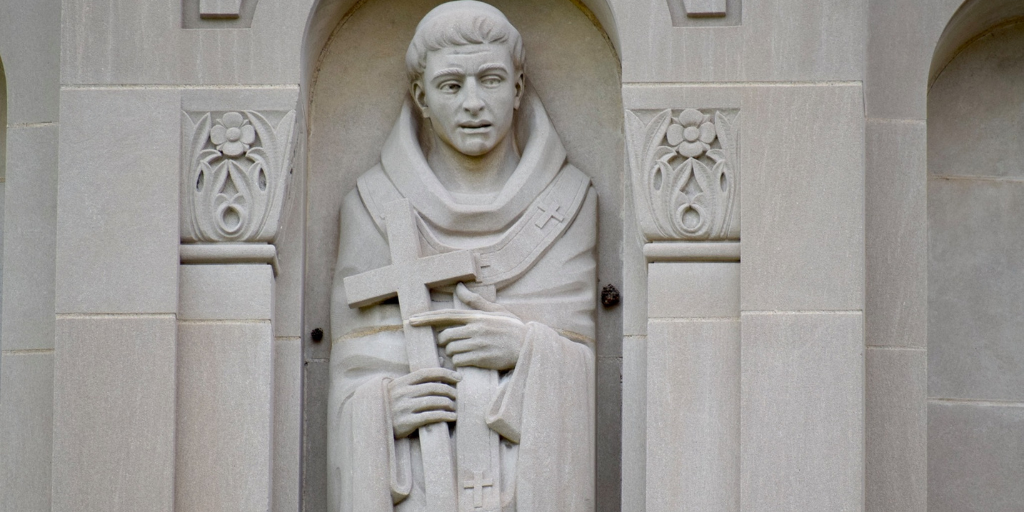
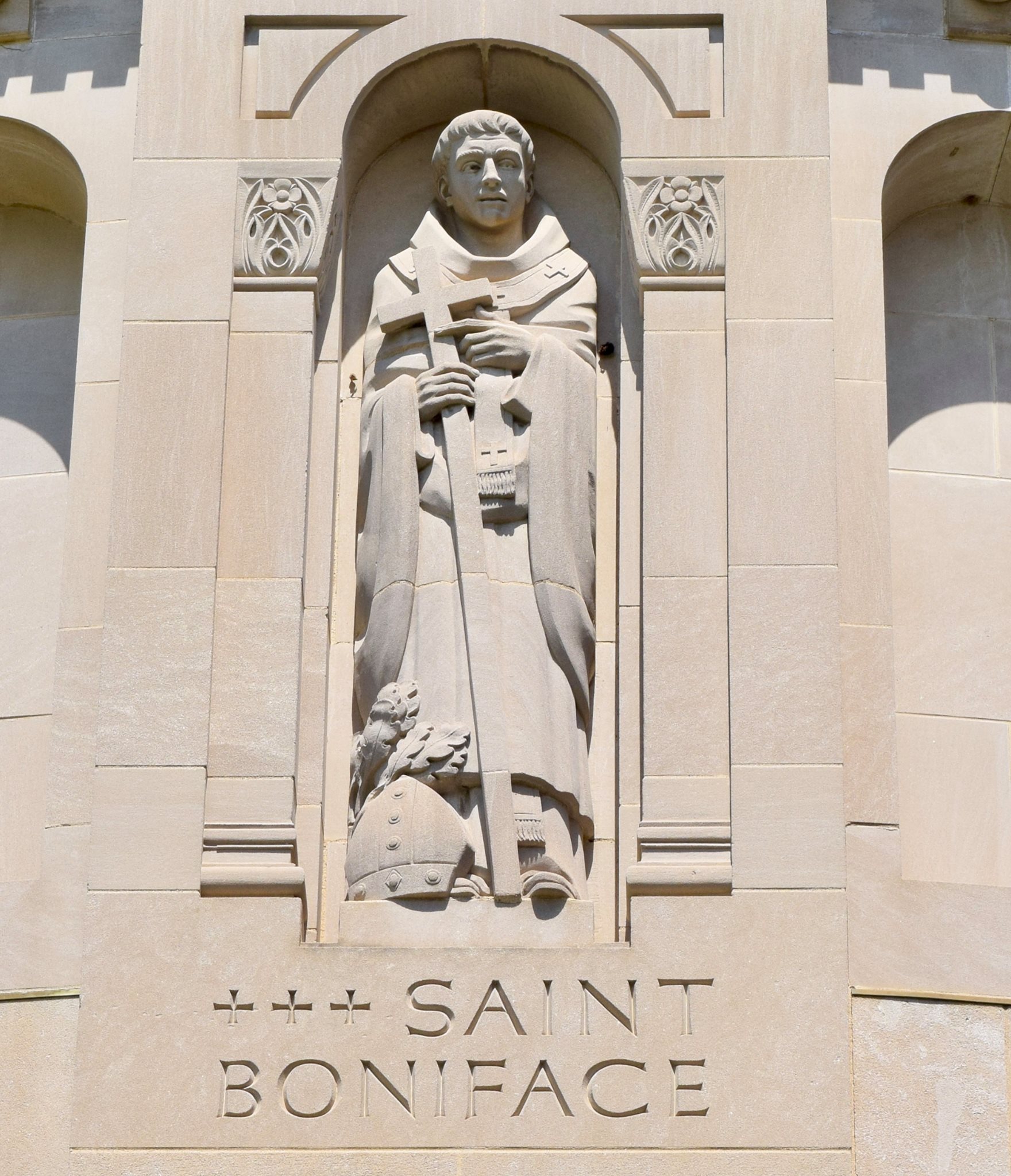
In the Basilica, you can find St. Boniface portrayed in the north façade. He is known as the patron saint of Germany.
Sources:
Butler’s Lives of Saints, ed. Bernard Bangley.
“Saint Boniface,” Franciscan Media.
The Way of Saints, Tom Cowan.