
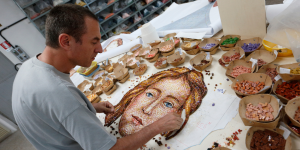
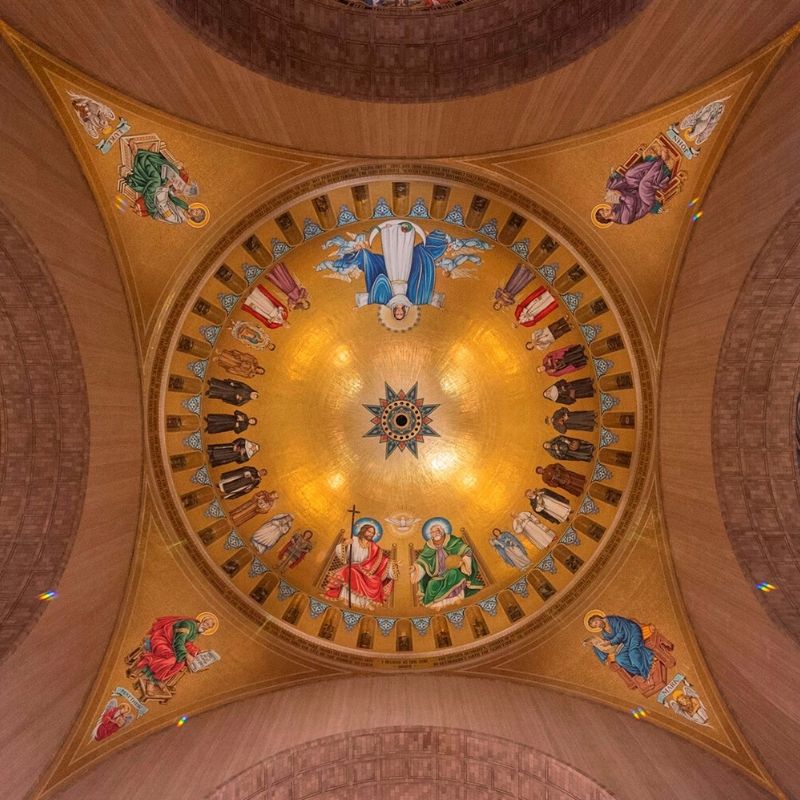
Considered the “crowning jewel” of the Basilica, the Trinity Dome was the largest and final dome to be completed in the Great Upper Church. From the initial hand-drawn sketches in Italy to the fascinating installation process in Washington, D.C., the creation of the Trinity Dome was truly a marvel. This week, as we celebrate the Solemnity of the Most Holy Trinity, we invite you to discover five fun facts about this stunning piece of sacred art.
 1. The Trinity Dome took over two years to complete.
The process for the Trinity Dome began in northern Italy, where artists created a design featuring the Holy Trinity, the Immaculate Conception, and a litany of North American saints. Once the image was approved by the National Shrine’s iconography committee, the artists began the process of enlarging it by hand. After the image was enlarged to a collection of full-scale drawings, the design artists divided it into numbered sections.
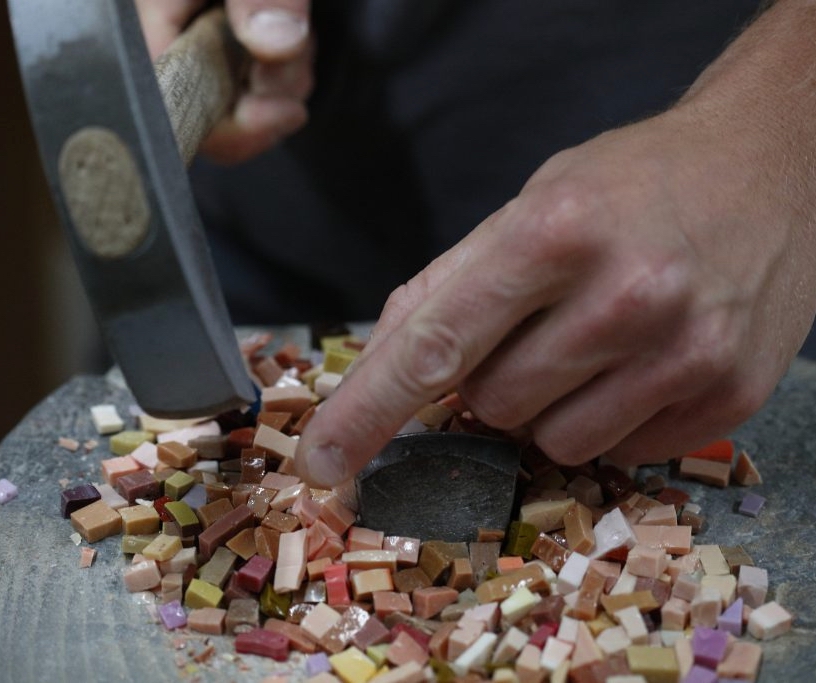
2. Each piece was individually shaped using a hammer and chisel.
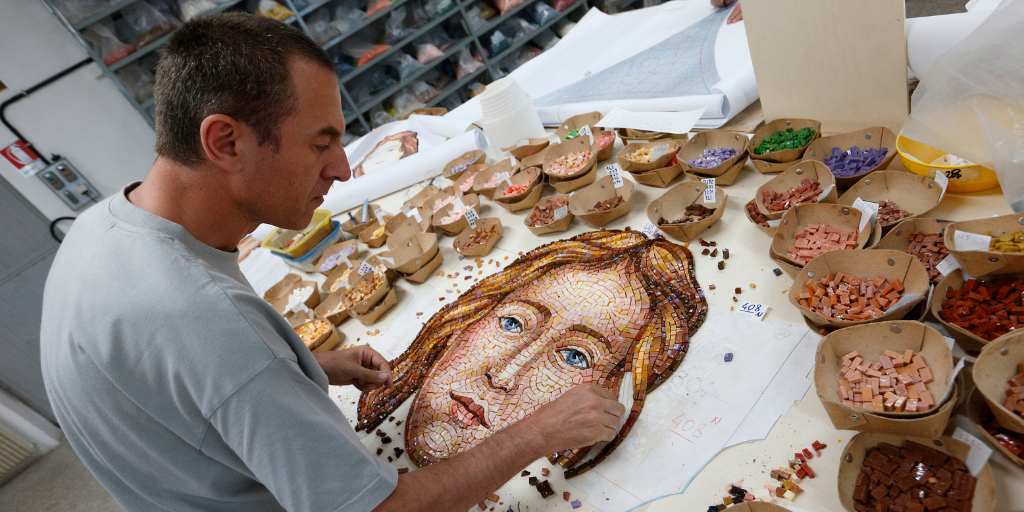
Once complete, the full-scale sketches of the dome were passed along to the mosaic artists, who began the process of color-coding mosaic tiles by hand, delineating more than 1,000 variations of handmade Venetian glass. Because every tile was created for a specific place on the mosaic, if the tile broke incorrectly while being chiseled, the artisan had to take another piece of glass and begin the process again.
You can watch the video below to see an artist at work creating the face of Mary.
3. The mosaic was first created in reverse.
The artisans at Travisanutto Giovanni company fabricated the mosaic using the reverse – or indirect – method. Invented in Italy in the late 19th century, this method allows for the creation of mosaics of a much greater scale, in a more reasonable timeframe, and at a more reasonable cost. The mosaic is created in reverse, with the glass tiles temporarily affixed right-side down on large sections of paper. The adhesion is achieved using a paste made from flour and water. This process ensures that once every section of mosaic is delivered to the site for installation, artisans will cement the sections to the surface of the dome according to precise mapping. The paste is then scrubbed off to expose the mosaic tiles.
This is an incredible advancement from the prior method, known as the direct method, in which the glass tiles were directly cemented to a surface right-side up and piece by piece, rather than section by section, taking at least three times as long to create the finished art piece.
4. Over 24 tons of mosaic tiles were packed into wooden crates and shipped by air and boat from Italy to Washington, D.C. to be installed.
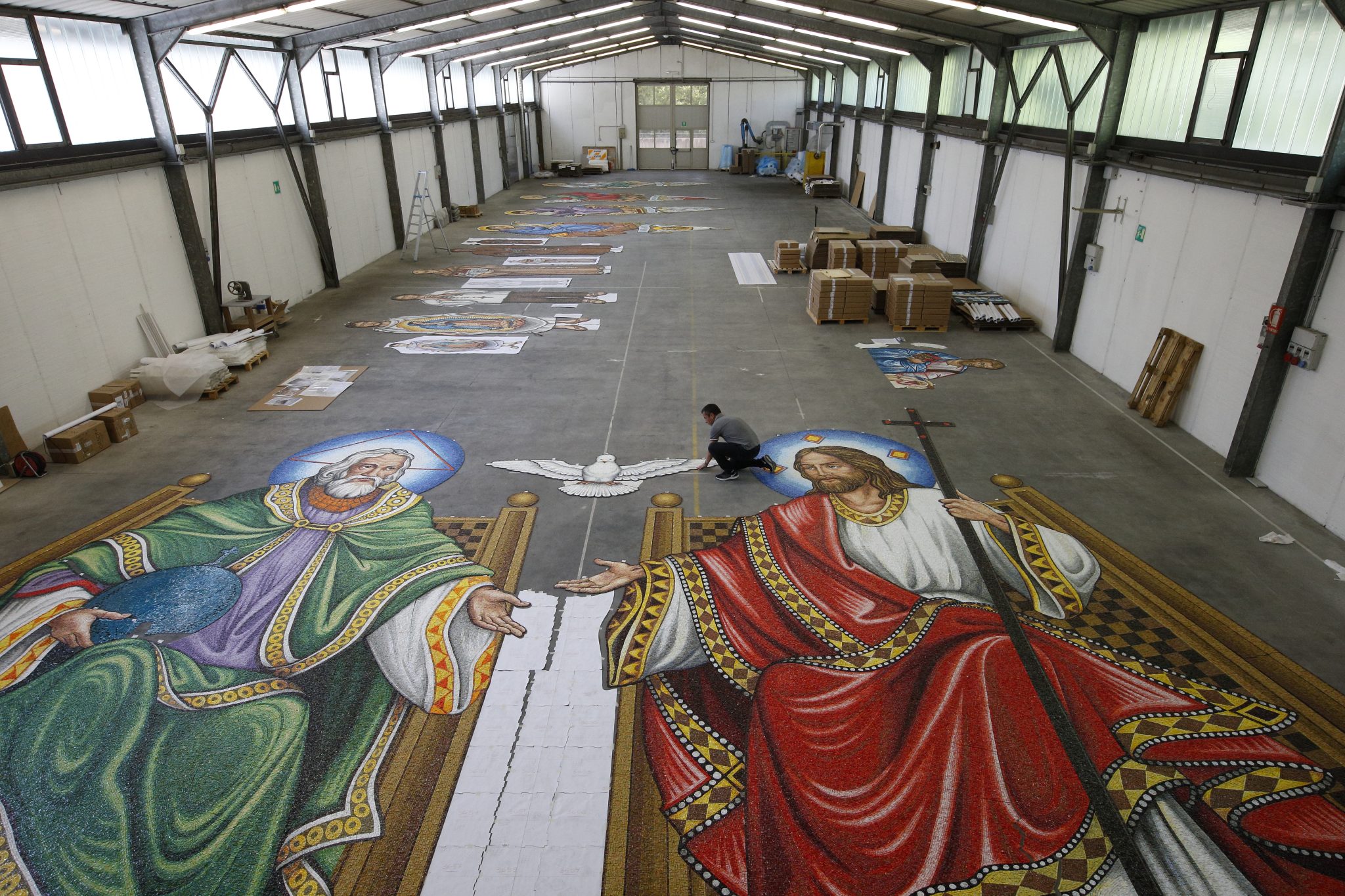
Artisans laid out the 30,000 separate sections of the Trinity Dome mosaic on the floor of a large warehouse in Italy, arranging each figure in full before packaging it into boxes for shipment.
Once the wooden crates arrived at the Basilica, a construction elevator lifted them and delivered the different sections to their places on the 13 floors of scaffolding. In order to prep the inside of the dome for the installation, workers had to strip all the original plaster off the walls of the dome. Then, over the course of weeks, the tile pieces were attached to the ceiling. Because the National Shrine remained open to the public during the installation process, a fully enclosed specialized scaffolding system was installed to allow crews to work in the space without disrupting visitors and prevent dust and debris from entering the sanctuary.
5. The Trinity Dome was made with 14 million individual tesserae.
On December 8, 2017, the Trinity Dome Mosaic was dedicated, marking the completion of the National Shrine according to its original architectural and iconographic plans. Described as the “crowning jewel” of America’s Catholic Church, the mosaic covers a total of 18,299 square feet! Pictured in the mosaic are the Blessed Trinity, the Immaculate Conception, 18 saints, two archangels, four choir angels, and four evangelists. It is the third dome on the path to the Christ in Majesty mosaic, and the central dome of the Great Upper Church.
Source:
Rohling, Geraldine M., PhD, MAEd. The Basilica of the National Shrine of the Immaculate Conception: Guide and Tour Book. Washington, D.C.: Basilica of the National Shrine of the Immaculate Conception, 2018.