How much do you know about Saint Pope John Paul II? Do you know what is special about his relationship to the National Shrine, or how many people he encountered over the course of his papacy?
The longest-serving pope of the 20th century, Pope John Paul II not only helped end the Cold War, but left behind a legacy of scholarship that would shape Catholic thought for decades to come. Today, his encyclical Evangelium Vitae remains an important expression of the Catholic Church’s defense of the sanctity of life and the dignity of the human person.
As we celebrate his memorial on October 22, we invite you to discover five key facts about his life and be inspired by his bravery, compassion, and wisdom.
1. He studied at an underground seminary during the Nazi occupation of Poland.
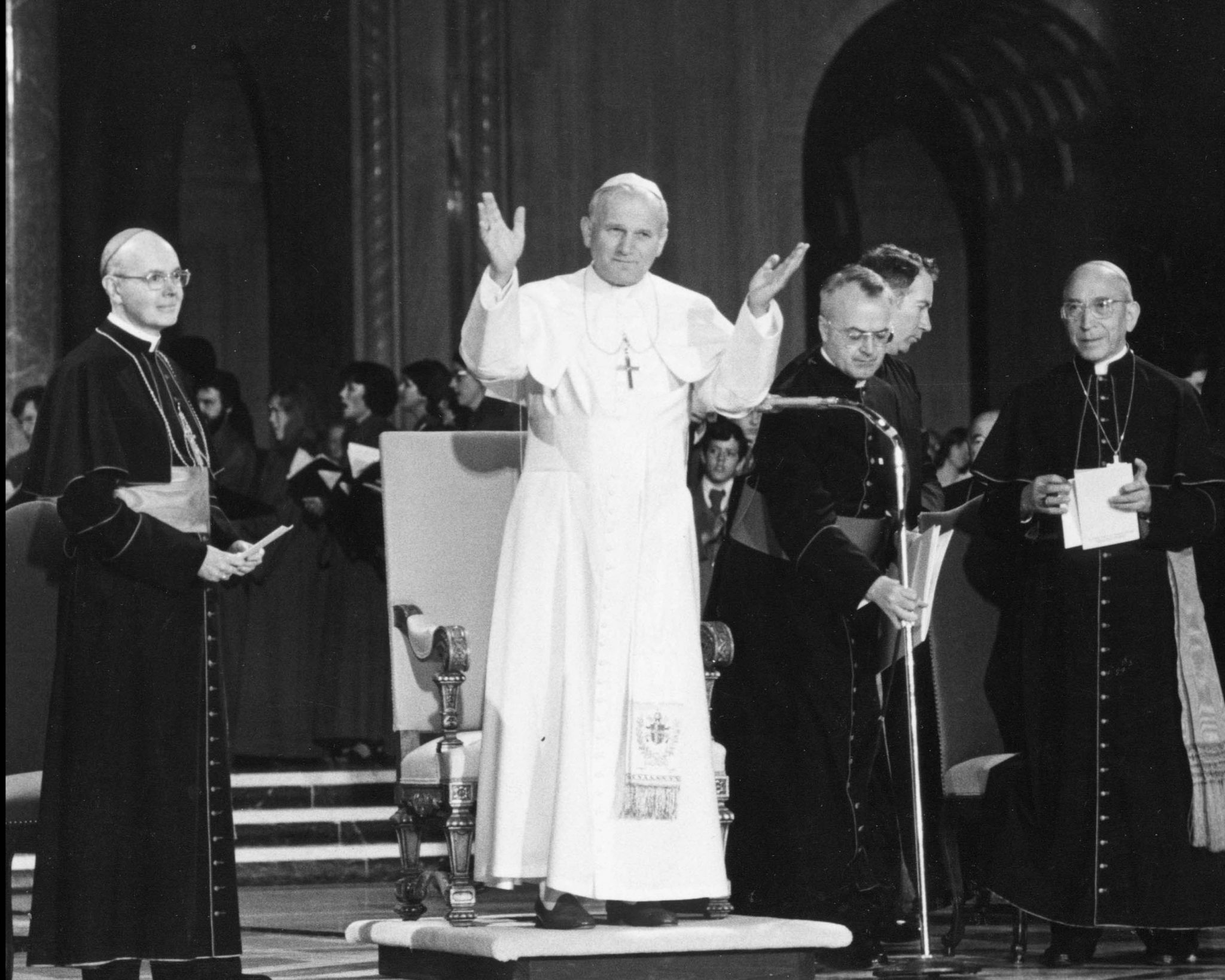
On May 18, 1920, Karol Józef Wojtyła was born in Wadowice, Poland. After his graduation from high school, his further education was impacted by the invasion of Poland by Nazi Germany. When the German occupation brought his studies at the Jagiellonian University of Krakow to a halt, he later studied at an underground seminary and was ordained in 1946. About two years later, he earned his doctorate in theology, and went on to become a professor of moral theology and ethics in the major seminary of Krakow.
2. Pope John Paul II was the first reigning pope to visit the National Shrine.
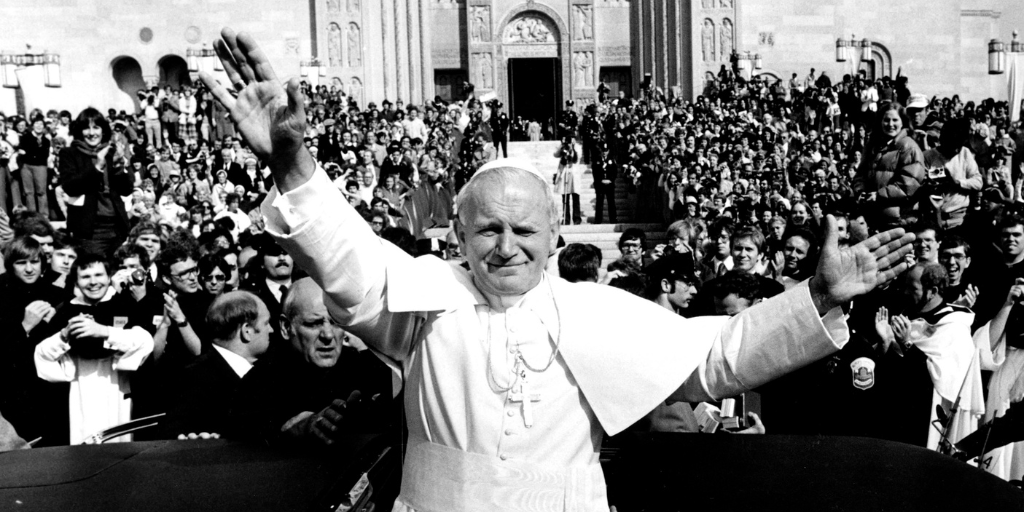
On October 16, 1978, Karol Wojtyła was elected Pope, choosing the name John Paul II. Less than a year later, on October 7, 1979, he became the first reigning pope to come to the National Shrine. During his visit, he expressed the powerful impact and significance of this shrine:
“This Shrine speaks to us with the voice of all America, with the voice of all the sons and daughters of America, who have come here from the various countries of the Old World. When they came, they brought with them in their hearts the same love for the Mother of God that was characteristic of their ancestors and of themselves in their native lands.”
3. Over the course of his papacy, Pope John Paul II traveled to over 120 countries.
Prior to Saint John Paul II’s papacy, previous popes rarely traveled outside the confines of the Vatican City State. He made it his mission to visit the faithful in all parts of the world, spreading the Gospel to millions of people and earning him the moniker “the Pilgrim Pope.”

4. He was shot with multiple bullets in an assassination attempt.
During the Cold War, Pope John Paul II inspired hope among the politically oppressed through his tireless fight for justice and solidarity. On May 13, 1981, the Feast of Our Lady of Fatima, he was traveling in an open car in Saint Peter’s Square when he was pierced by multiple bullets in an assassination attempt – one of which hit his lower abdomen, causing extreme bleeding. After five hours of surgery and a lengthy hospital stay, he returned to his ministry and graciously forgave his assassin. He attributed his miraculous recovery to Our Lady of Fatima, remarking, “one hand pulled the trigger, another guided the bullet.”
5. His Wednesday General Audiences were attended by 17.6 million people.
Pope John Paul II had a gift for reaching people of all ages in all places. Not only did he encounter more individuals than any other pope, but he also spoke 10 languages!
Here at the National Shrine, we are proud to honor Pope John Paul II’s legacy of justice, bravery, and compassion throughout our sacred art. You can find him portrayed in the Our Lady of Czestochowa Chapel, the Universal Call to Holiness Sculpture, the Trinity Dome mosaic, and a sacristy window.
Sources:
Biography of John Paul II, The Vatican.
“‘I was in shock’: Polish cardinal recalls assassination attempt on St. John Paul II,’” EWTN News.
“John Paul II: A Biographical Sketch,” Loyola Press.
“The polyglot popes: How language builds bridges in the Church,” EWTN.
Tucker, Gregory W. (2000). America’s Church: The Basilica of the National Shrine of the Immaculate Conception. Huntington, IN: Our Sunday Visitor. ©Basilica of the National Shrine of the Immaculate Conception.