
Did you know that St. René Goupil is one of eight canonized North American martyrs? A skilled surgeon, he was eager to use his talents to help others. Even as he became deaf and suffered from other health problems, he was willing to go wherever God called him, no matter the cost. As we celebrate his birthday this week, we invite you to learn about his perilous mission, persecution, and martyrdom.
Early Life of René Goupil
René Goupil was born in Anjou, France, on May 13, 1608. As a young man, he wished to take orders with the Jesuits in Paris, but due to his poor health and onset of deafness, he only became a lay assistant. Despite these physical challenges, René had a willing heart and wished to put his skills as a surgeon to use. So in 1640, he volunteered to travel to Quebec to minister to the French settlers and Algonquin Indians in the surrounding region. Not only did he care for those in the hospitals, but he also performed manual labor in the Jesuit House in Quebec.
René Meets Father Jogues
Though René enjoyed his ministry at the hospital, he wanted to work more directly with the indigenous populations. After he had served in Quebec for two years, he found just such an opportunity with Father Isaac Jogues, who sought medical assistants to help him minister to the Hurons. He warned René that the mission would be fraught with perils; there was conflict between the Iroquois and the Hurons, and besides that, other challenges likely awaited them. But René felt called to the mission, whatever the risks might be.
Together, along with a group of Hurons, the two men set out on a flotilla up the Saint Lawrence River. They were only on the second day of this journey when a group of 70 Iroquois ambushed and captured them, subjecting them to unspeakable torture. Accounts from Father Jogues describe how he and René were beaten with iron rods and clubs, and even had parts of their fingers severed. Over the course of a week, René in particular suffered severely, being tied to the ground and pelted with hot cinders and burned by coals. Their captivity continued for six weeks, and all the while, Father Jogues could sense that a great evil awaited them.
The Martyrdom of René
Throughout their captivity, Father Jogues noted how René accepted their fate with peace, seeking only to submit himself to God’s will. Even when Father Jogues suggested an escape attempt, René would not consider it, believing that God had placed him where he was meant to be. During that time, René also took the vows of a Jesuit brother and was consecrated by Father Jogues.
Ultimately, René was martyred by the Iroquois, receiving three tomahawk blows to the head after he had made the sign of the cross over one of their children. He and Father Jogues began reciting the Rosary, and as René breathed his last, the name of Jesus was on his lips. He passed away on September 29, 1642.
St. René Goupil’s Legacy
Unfortunately, only fragments of René’s remains were recovered and buried by Father Jogues. In one of his letters, Father Jogues remarked:
“He deserves the name of martyr, not because he had been murdered by the enemies of God and His Church while laboring in ardent charity for his neighbor, but most of all because he was killed for being at prayer and especially for making the sign of the cross.”
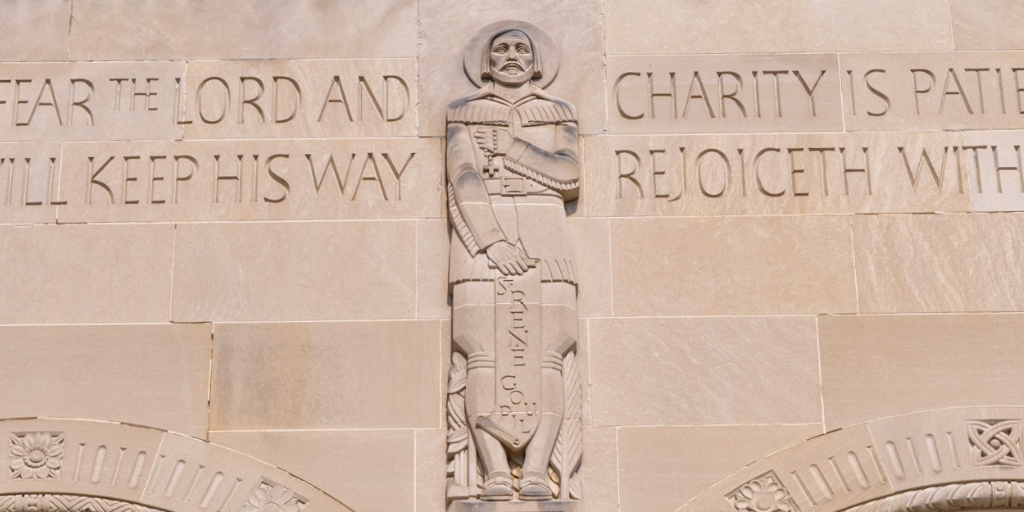
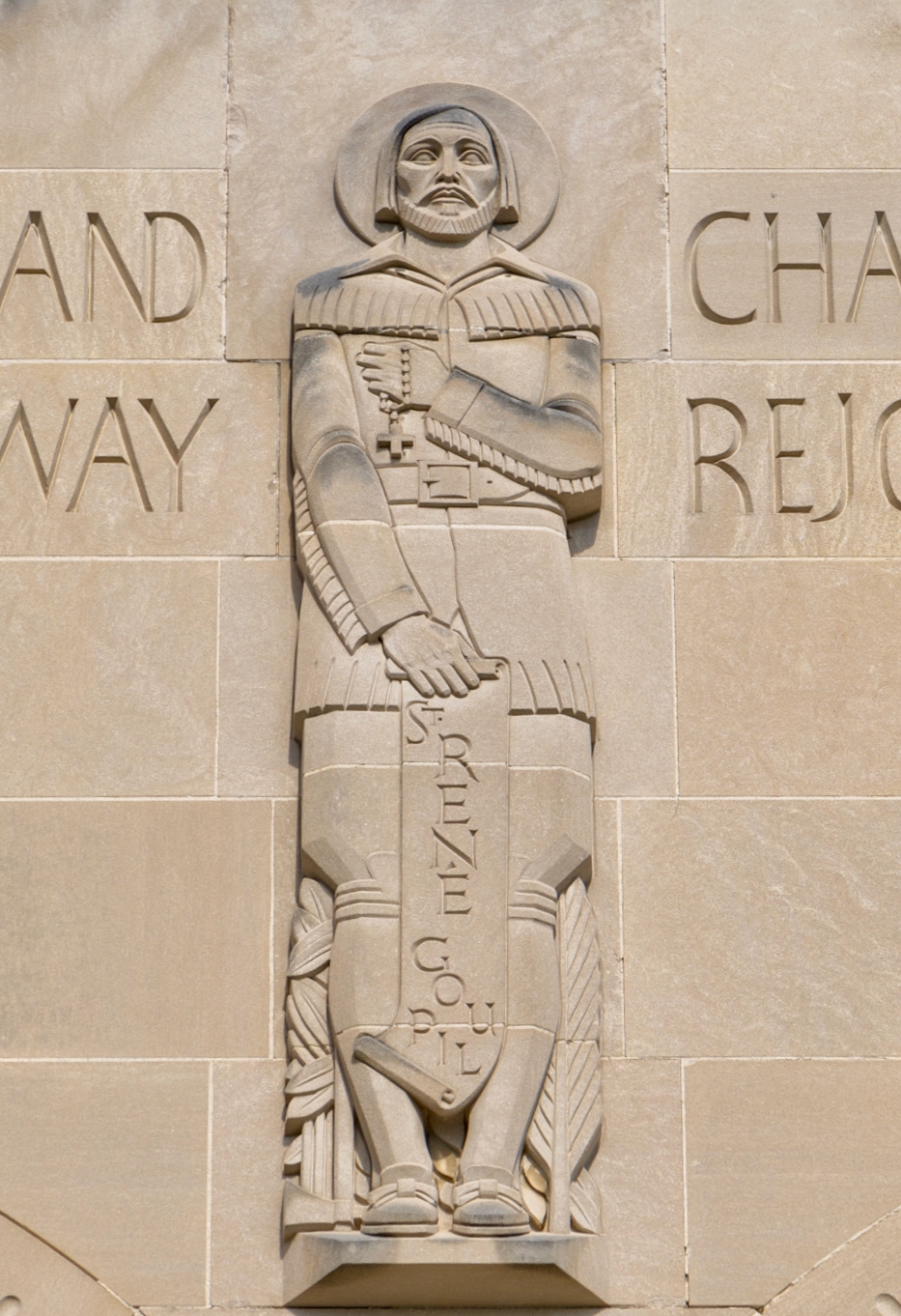
On June 29, 1930, Pope Pius XI canonized René Goupil along with seven other North American martyrs. In the Basilica, you can find René portrayed in the west portico.
Sources:
“Death Under the Sign of the Cross: St. René Goupil,” National Catholic Register.
“René Goupil,” Loyola Marymount University.
“Saint René Goupil,” The Jesuits.
“Saint René Goupil, SJ,” The Jesuits Prayer Ministry Singapore.