Born into Italy’s upper class during the 3rd century, St. Agatha could have made an advantageous marriage and lived in luxury. Instead, she chose to dedicate herself to the Lord – even when it meant facing persecution and torture. As we celebrate her Memorial on February 5, we invite you to learn more about her story and explore where she is portrayed at the Basilica in immersive 360° – take the virtual tour below!
Early Life
While the historic accounts of Agatha’s life are limited, it is believed that she was born near Mount Etna in Sicily to an affluent nobleman in approximately A.D. 235. As a young girl, she underwent the ritual of “velatio” (taking the veil) to mark herself as a virgin for Christ, and received a red veil to wear as a symbol of her promise.
Agatha grew into an accomplished young woman, and soon caught the eye of a Roman official named Quintian, who attempted to woo her. At this time, Christians in Italy were suffering from persecution under Emperor Decius. However, Agatha did not let fear dictate her decisions, and resolved to continue living married to Christ, spurning Quintian’s advances.
The Persecution and Death of St. Agatha
Infuriated by Agatha’s rejection, the official did all in his power to make Agatha suffer for her faith. In an attempt to spoil her purity, he forced her to work in a brothel, but by God’s grace she remained unharmed. She was then returned to Quintian, who placed her on trial for her faith. Once again, she refused to deny Christ, and was subjected to an unnecessary mastectomy. Still Agatha did not waver in her belief, and was then sentenced to be stripped of all her clothes except her red veil and raked across burning coals. While she was being tortured, an earthquake occurred, and many townspeople rushed to the court and begged the officials to stop. Agatha was removed from the coals and returned to jail miraculously unharmed, with her veil still intact.
One account states that after this experience, she pleaded with the Lord to take her to heaven, and on February 5, A.D. 251, the Lord answered her prayer. Because of her experiences, St. Agatha is recognized as the patroness of those suffering from breast cancer and disease.
Virtually Tour the St. Agatha Chapel
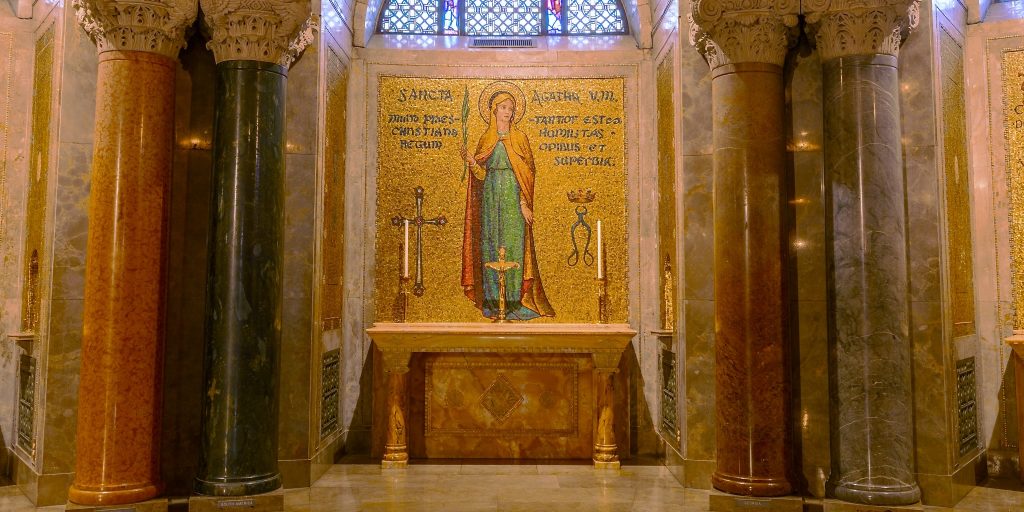
Here at the Basilica, St. Agatha is portrayed in a glittering chapel in the West Apse of the Crypt Church, along with five other women of faith who are remembered in Eucharistic Prayer I, the Roman Canon. You can explore the chapel in stunning 360° with our virtual tour below!
Sources:
Rohling, Geraldine M., PhD, MAEd. The Basilica of the National Shrine of the Immaculate Conception: Guide and Tour Book. Washington, D.C.: Basilica of the National Shrine of the Immaculate Conception, 2018.
“Saint Agatha,” Franciscan Media.
“St. Agatha, Virgin and Martyr,” Vatican News.