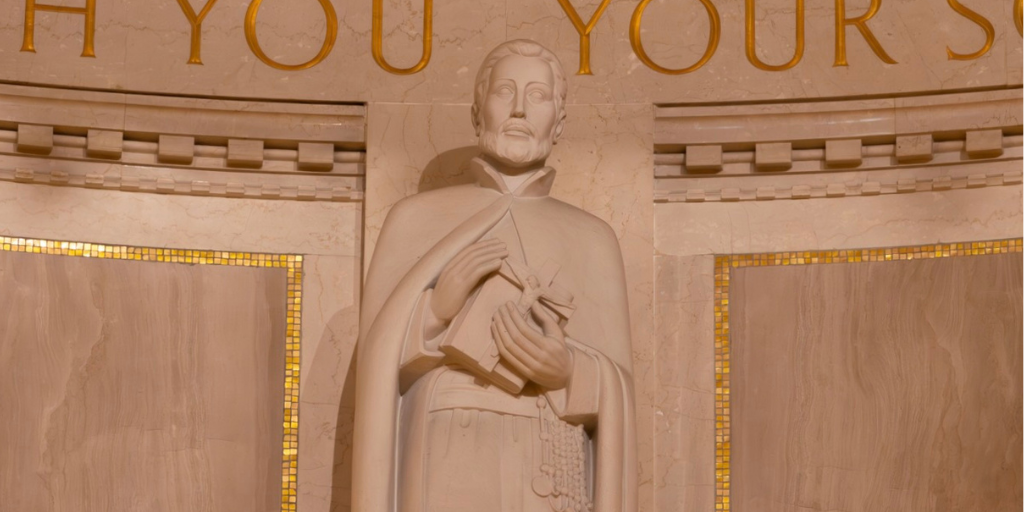
Recognized as the patron saint of missions, St. Francis Xavier led a ministry that was uniquely focused on cultural assimilation. In his 18 years of missionary work, Francis learned a new language, traveled hundreds of miles, and baptized thousands of converts, demonstrating not simply a zeal for the Gospel, but a heart for the people. As we celebrate his Memorial on December 3, we invite you to discover five things you should know about his life and ministry.
1. Francis Xavier studied at the University of Paris alongside Saint Ignatius of Loyola.
Born in 1506, Francis grew up in Navarre, Spain, where his father oversaw the king of Navarre’s council. When he was old enough, he began studying at the University of Paris, where he met Ignatius of Loyola. Through their friendship, Francis realized that God was calling him to work in ministry, and in 1534, he decided to join Ignatius in founding the Society of Jesus. Three years later, Francis was also ordained as a priest.
2. He once spent 13 months at sea.
Not only did Francis make vows of poverty and chastity when joining the Society, but he also promised to spread Gospel. To help fulfill the Society’s aim of sending missionaries into foreign lands, Francis departed for Goa in 1541. Unfortunately, he suffered from severe seasickness, making the 13-month voyage an arduous journey.
3. To make the Gospel accessible to Goa’s lower classes, he set verses to popular tunes of the era, and soon, the Scriptures were sung across the region.
Though Christianity was somewhat established in Goa, Francis soon discovered that many of those who claimed the name of Christ lived in shameless hedonism. Mistreatment of slaves and women, and a disregard for impoverished people characterized the lives of these nominal Christians. Francis determined to inspire true holiness not only through his personal conduct, but through unconventional practices. To make the Gospel accessible to the lower classes, he set verses to popular tunes of the era, and soon, the Scriptures were being sung across the region.
He also ministered to unbelievers through humanitarian work, assisting in the leper community, hospitals, and prisons. Francis later ventured beyond Goa to the surrounding areas, where he dressed like a pauper in order to better relate to the locals.
4. After spending just two years in Japan, Francis helped lead nearly 2,000 people there to Christ.
After ministering in Goa and India for several years, Francis felt called to continue his mission work in Japan alongside a small group of fellow Catholics. At the time of the group’s arrival in Kagoshima in 1549, Japan was largely untouched by the West. Francis spent the majority of his first year there studying Japanese and translating theological works into the language so that he could more effectively share the Gospel. Through these efforts, he began converting some of the locals to Christianity. Displeased by his growing influence, Kagoshima’s Buddhist leaders had Francis barred from the city. He then began preaching in other parts of the nation, and after just two years, had helped lead nearly 2,000 people to Christ.
5. In Goa, Francis dressed like a beggar to blend in – but in Japan, he dressed in fine robes and had his fellow missionaries pretend to be his attendants.
While assimilation once again helped Francis better reach people, the task looked very different in Japan. Instead of dressing humbly like he did in Goa, Francis found that more people were interested in speaking with him if he appeared wealthy and important. So, as he continued his ministry, he dressed in fine robes and had his fellow missionaries pretend to be his attendants. As a result, some officials liked him so much that they permitted him to freely hold services in an unused Buddhist temple. During his time in Japan, Francis helped plant the seeds of a ministry that would continue to flourish as more missionaries came to the country.
In the years that followed, Francis sought to minister to the people of China, but tragically fell ill on his voyage there and passed away on an island six miles off the coast. He was canonized on the same day as St. Ignatius of Loyola in 1622.
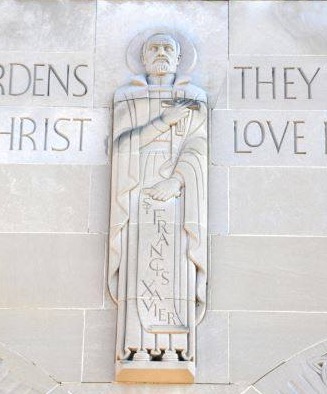
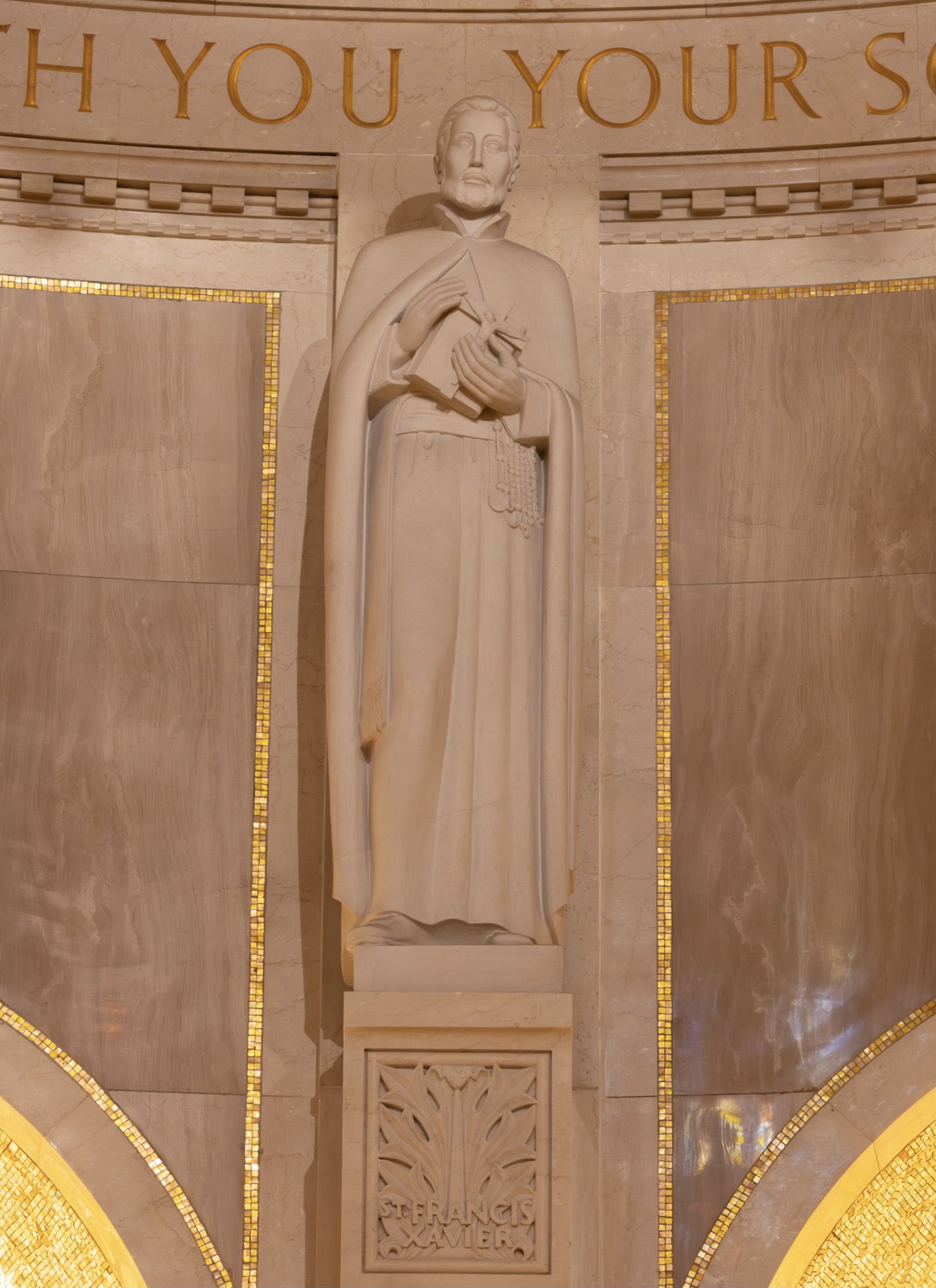
At the National Shrine, you can find St. Francis Xavier portrayed in the west portico and in the west apse of the Great Upper Church.
Sources:
Butler’s Lives of Saints, ed. Bernard Bangley.
Rohling, Geraldine M., PhD, MAEd. The Basilica of the National Shrine of the Immaculate Conception: Guide and Tour Book. Washington, D.C.: Basilica of the National Shrine of the Immaculate Conception, 2018.
“St. Francis Xavier,” Britannica.
“St. Francis Xavier,” Catholic News Agency.
“St. Francis Xavier,” New Advent.
The Way of Saints, Dr. Tom Cowan.