
How much do you know about Saint Leo the Great? Do you know what he shares in common with Pope Gregory, or what doctrine he helped the Church clarify?
A dedicated theologian and diplomat, Saint Leo the Great provided much-needed leadership for the Church during the fall of Rome. As we celebrate his memorial on November 10, we invite you to learn five facts about his life and legacy.
1. He was the first pope to choose the name Leo.
Little is known about Leo’s early life, except that he was born in Tuscany in the beginning of the fifth century. In approximately 430 A.D., Leo earned a place as a deacon of the Church of Rome, and about a decade later, was consecrated as the new Pope. Since his papacy, 13 other popes have adopted the name Leo – most recently, Pope Leo XIV!

2. He convinced Attila the Hun to halt an attack on Rome.
Perhaps the most notable event of Leo’s papacy took place in 452, when he rescued Rome from destruction by the Huns. After Attila and his army invaded Italy and prepared to march upon Rome, Pope Leo and two Roman senators approached him unarmed, and begged him to halt the attack. Because of Leo’s diplomacy, Attila conceded to his request, and departed from the peninsula.
Around 455, when Genseric’s Vandals attacked Rome, Leo also succeeded in convincing them to spare the Archbasilica of St. John Lateran and the Basilicas of Saints Peter and Paul, which served as shelters to thousands of civilians.
3. Leo I was the first pope to be known as “the Great.”
Besides his impressive diplomatic and political accomplishments, Pope Leo the Great also was an insightful and prolific theologian. At the time of Leo’s papacy, there was division in the Church over the true nature of Christ. In 451, when 350 bishops gathered together in the Council of Chalcedon to discuss Christology, Leo developed a terminology which allowed the Church to clarify the confusion that had emerged regarding the humanity and divinity of Christ. In the treatise presented to the Council, Leo stated that Christ is “one Person [with] two natures,” concisely articulating a key Christian doctrine (Butler).
Leo’s papacy lasted 21 years, and over the course of his life, he wrote 96 sermons and over 100 letters.
4. Leo I is one of only two popes to be recognized as a Doctor of the Church.
In 1754, St. Leo was declared a Doctor of the Church by Pope Benedict XIV, in recognition of his efforts to strengthen the “authority and prestige” of the Roman See. Thanks to Leo’s wisdom and guidance as pope, the Church continued to act as a “steadying international institution” throughout the medieval era (Butler).
The other pope recognized as a Doctor of the Church is Pope Gregory the Great, who was one of the first saints granted this title in the 13th century.
5. He was the first pope to be buried in St. Peter’s Basilica.
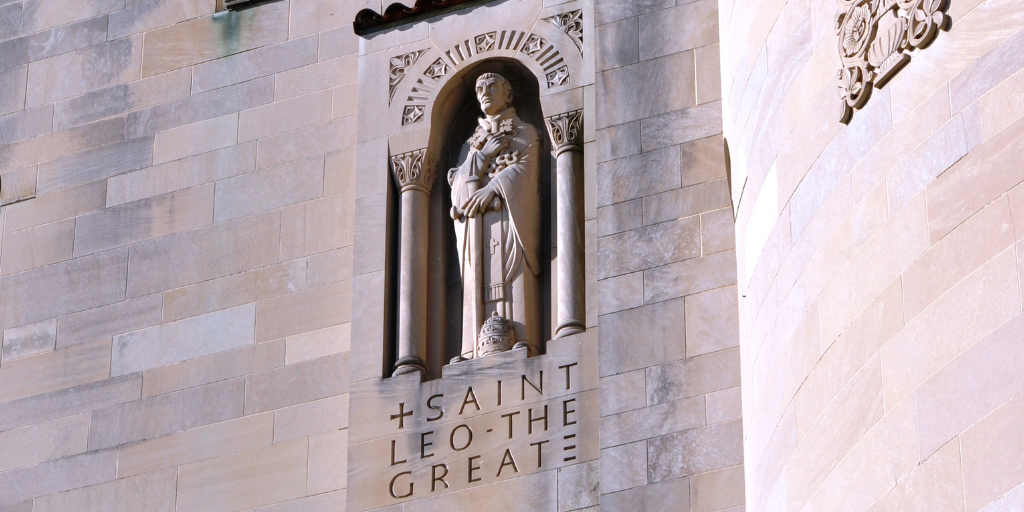
In honor of his association with St. Peter, St. Leo the Great’s remains were placed near St. Peter’s tomb, and his relics can be found at the Vatican Basilica. Here at the National Shrine, you can find him portrayed in the East Façade.
Sources:
Butler’s Lives of Saints, ed. Bernard Bangley.
“Saint Leo I,” Britannica.
Speech of Benedict XVI, The Vatican.
“St. Leo the Great, Pope and Doctor of the Church,” Vatican News.