
How well do you know the story of St. Benedict? Do you know what era he was born in, or how he was almost murdered?
The founder of one of the largest religious orders in the world, St. Benedict not only lived a fascinating life – his spiritual impact has endured for over 1,500 years. As we celebrate his memorial on July 11, we invite you to learn five facts about his life and legacy.
1. St. Benedict lived as a hermit for three years.
When St. Benedict was born in 480 A.D., the Western Roman Empire had only just fallen. By the time he went to study law and literature in Rome as a young man, the region was still fraught with political turmoil and cultural dysfunction. The more Benedict witnessed his peers chase after worldly pleasures and vices, the more disillusioned he became, until he finally decided to retreat to modern-day Affile to join a group of priests.
In Affile, Benedict found both blessings and trials. According to tradition, he performed a series of miracles there, including fixing a wheat sifter that had been shattered by a servant. After gaining notoriety for these miracles, Benedict sought to distance himself from society and took residence in a cave near the ruins of Nero’s village. For three years, he lived as a hermit, limiting his interactions almost solely to his meetings with a fellow monk named Romanus and some local shepherds who sought his spiritual guidance.
2. St. Benedict was almost poisoned.
The next chapter of Benedict’s life was fraught with unexpected perils and responsibilities. When the men of one of the nearby monasteries at Vicovaro convinced him to become their abbot, Benedict expressed concern that his standards would prove too strict for them. It was not long before he encountered resistance – to the extent that another monk at Vicovaro attempted to poison him. However, God spared his life, and he retreated to Subiaco, a town between Rome and Naples.
There, Benedict founded 12 communities of monks, and a 13th as a training monastery for young monks. But once again, his notoriety and miracles angered other priests. Because of their opposition, Benedict left to establish the Abbey of Montecassino, which is now one of the world’s most famous monasteries.
3. He is the founder of the Benedictine order.
Though the building at Montecassino had formerly been an ancient pagan acropolis, Benedict transformed it into a place of holy service. It was there that he established the monastic order now known as the Benedictines, performed miracles, and started a work of evangelism to the pagans.
4. He wrote the Rule of St. Benedict, which became a foundational text for the operation of holy orders.
With its practical instructions for monastic life, the Rule became a foundational text for the operation of holy orders over the next 1,500 years. Characterized by its moderation and emphasis on balance, the Rule prescribed dividing the workday into nearly equal parts of manual labor, liturgical work, and theological study.
5. St. Benedict is the patron saint of Europe.
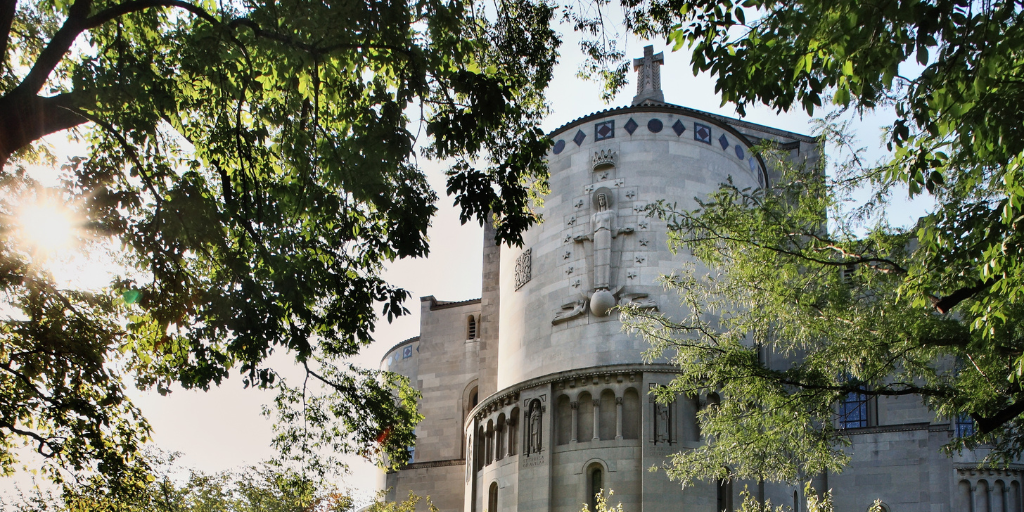
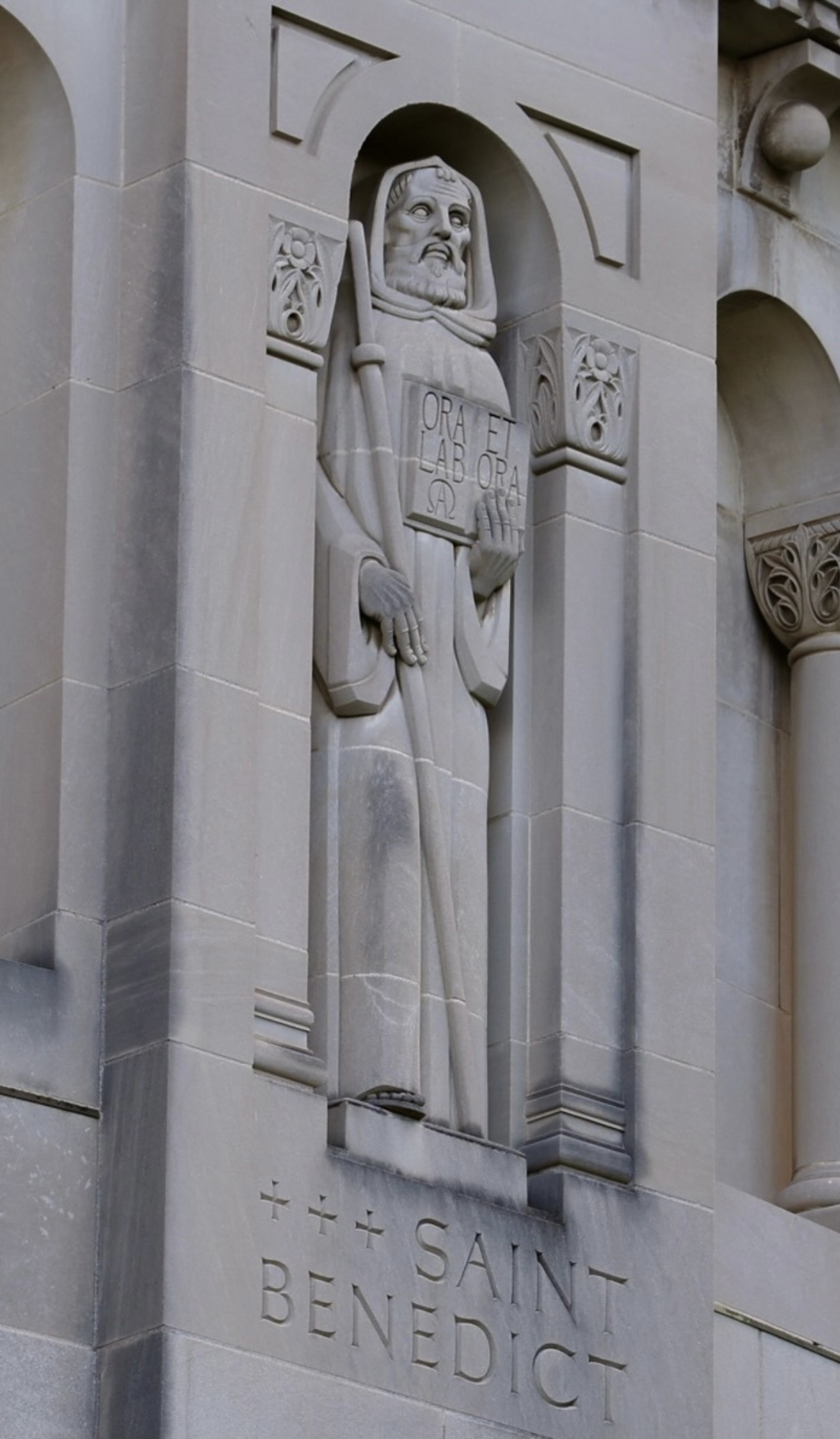
And that’s not all – he is also the patron of schoolchildren, kidney disease, monastics, and poisoning. Today, over 7,500 monks and 13,000 nuns and sisters belong to the Benedictine order, carrying on his legacy around the world. You can find St. Benedict portrayed in the North Façade of the Basilica.
Sources:
“A Life of Saint Benedict,” Saint Benedict Website.
“Saint Benedict,” Franciscan Media.
“St. Benedict,” Britannica.
“St. Benedict, Abbott, Patron of Europe,” Vatican News.