


How much do you know about St. Mark the Evangelist? Do you know where in the Bible he is first introduced, or what makes his Gospel account distinct?
As we celebrate the Feast of St. Mark the Evangelist on April 25, we invite you to discover six facts about this Gospel author and his ministry in the early Church.
1. Mark is first mentioned in Acts 12.
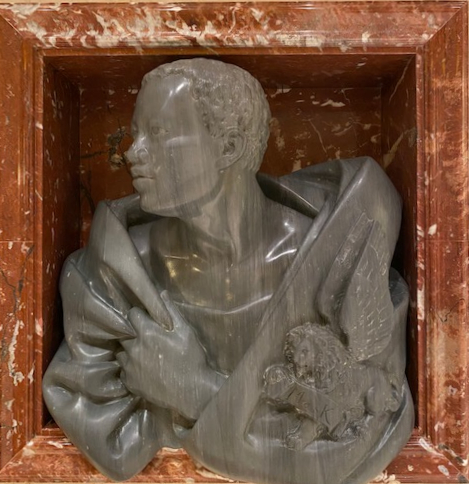
Although he was not a direct disciple of Jesus, St. Mark played a vital role as a missionary in the early Church, and is the author of a Gospel account. Also referred to as John Mark, he is first introduced in Acts 12 as the companion of Paul and Barnabas on their apostolic missions.
2. Mark is never mentioned by name in his own Gospel.
The only possible references are anonymous, and even these instances are debated by scholars.
3. Mark mentions the word “Gospel” more times than any of the other Gospel account authors.
In the book of Mark, the word “Gospel” is mentioned a total of eight times – double the total of four mentions found in Matthew, Luke, and John combined!
4. He was a cousin of Barnabas.
Colossians 4:10 reads:
“Aristarchus my fellow prisoner greets you, as does Mark the cousin of Barnabas, concerning whom you have received instructions—if he comes to you, welcome him.”
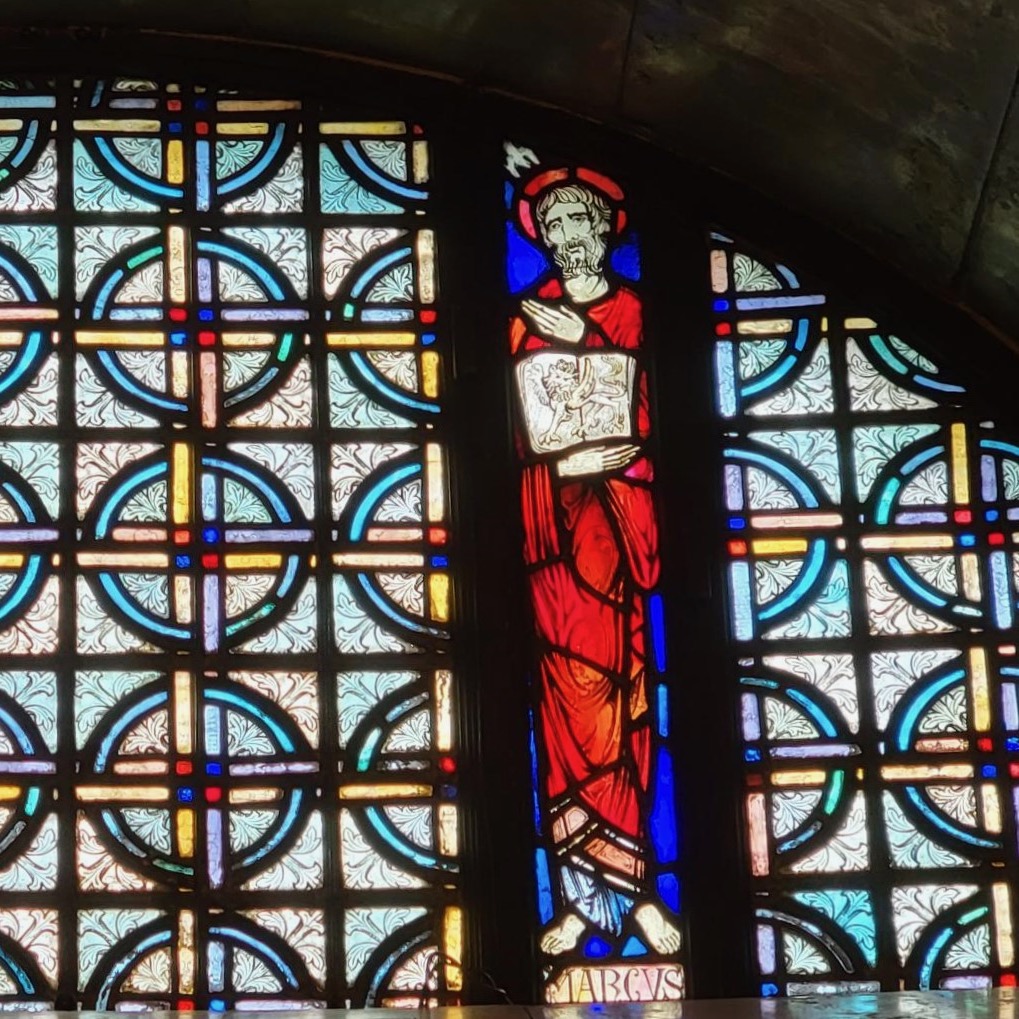
At one point, Mark’s decision to withdraw from Pamphylia became a point of contention between Paul and Barnabas, who then decided to separate. Barnabas went with Mark to Cyprus, while Paul continued with Silas to Syria and Cilicia. As Acts 15:36-39 records:
“After some days Paul said to Barnabas, ‘Come, let us return and visit the believers in every city where we proclaimed the word of the Lord and see how they are doing.’ Barnabas wanted to take with them John called Mark. But Paul decided not to take with them one who had deserted them in Pamphylia and had not accompanied them in the work. The disagreement became so sharp that they parted company; Barnabas took Mark with him and sailed away to Cyprus.”
However, the conflict was later resolved, as we see in Paul’s letter to the Colossians, where he refers to Mark in ways that indicate a degree of warmth and familiarity, calling him one of his “fellow co-workers in the kingdom of God” and a “comfort” to him. In 2 Timothy 4:11, Paul also remarks that Mark is “useful” in his ministry.
5. In sacred art, Mark is associated with a lion.
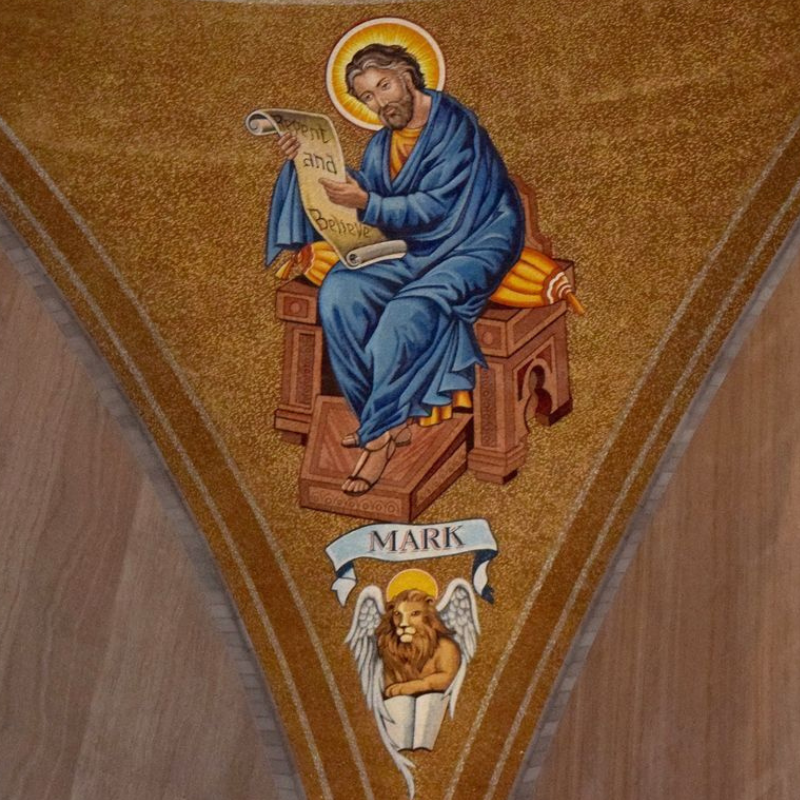
Oftentimes, a winged lion is used to depict St. Mark in sacred art. It is believed this symbol originated from Ezekiel’s description of the evangelists as winged creatures – one of which is a lion. As Ezekiel 1:6-10 reads:
“They were in human form, but each had four faces and four wings, and their legs were straight, the soles of their feet like the hooves of a bull, gleaming like polished brass. Human hands were under their wings, and the wings of one touched those of another. Their faces and their wings looked out on all their four sides; they did not turn when they moved, but each went straight ahead.
Their faces were like this: each of the four had a human face, and on the right the face of a lion, and on the left, the face of an ox, and each had the face of an eagle.”
6. Mark emphasizes the timeliness of Christ’s actions.
Throughout Mark’s Gospel account, the Greek word eutheos – translated as “straightaway” or “immediately” – appears over 40 times, evoking Christ’s unhesitating commitment to his earthly mission.
Additionally, reading Mark, you will notice that he starts many of the chapters with the word “and.” Though this may seem a small point of observation, this stylistic distinctive links each chapter to the section preceding it, indicating the completeness and perfection of Christ’s earthly ministry. There is no break in His ministry; it is a continuous series of acts of faith and service – in other words, a perfect life of devotion.