This month, we’re delighted to share the sixth post in our Walk Through Art blog series, highlighting the sacred art of the Basilica as it corresponds to important Church celebrations and moments in the life of the National Shrine. In this post, we invite you to discover three art pieces we’re highlighting this February – from the Presentation Chapel to the Our Lady of Lourdes Chapel!
February 2 – The Presentation Chapel
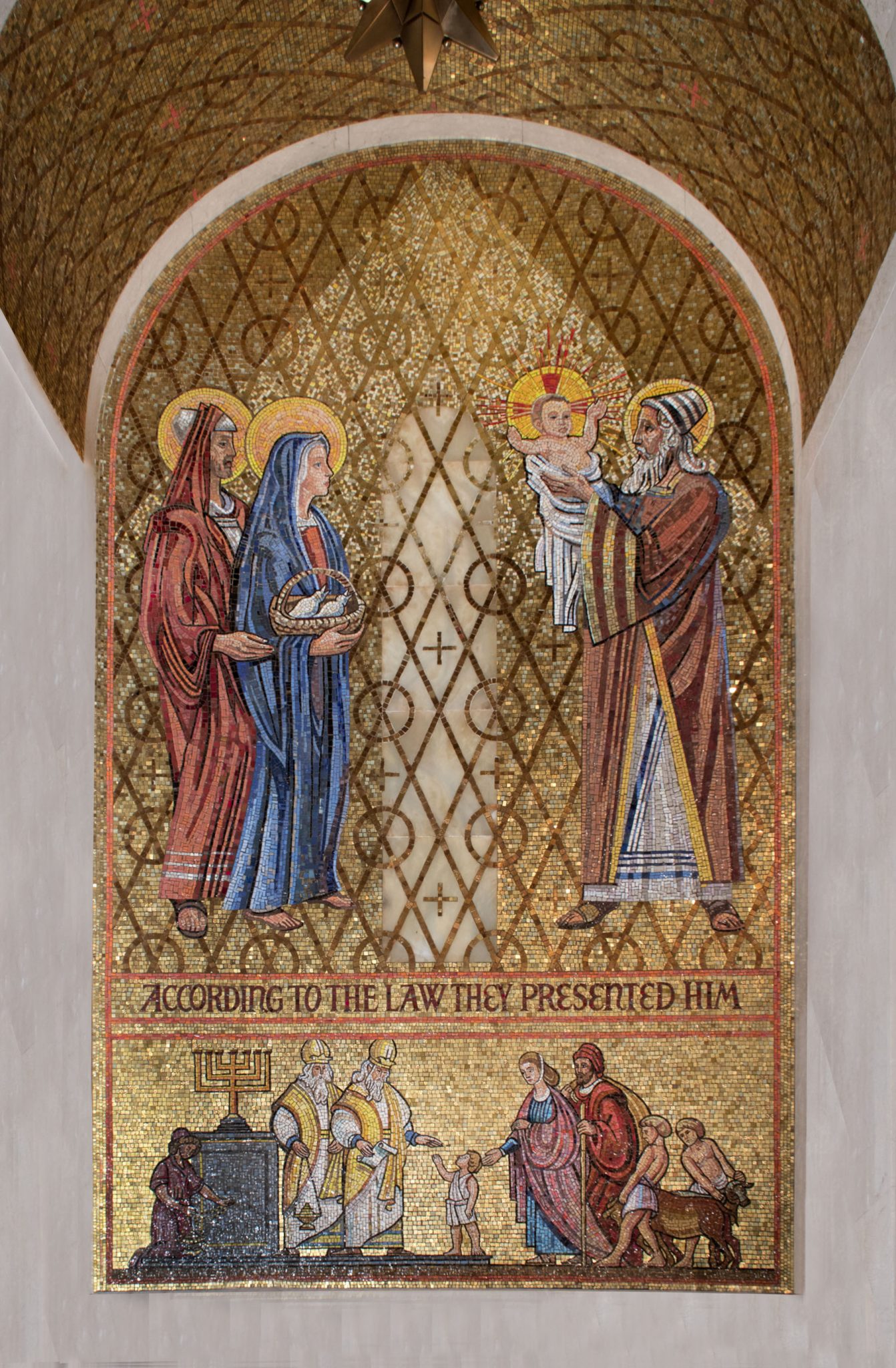
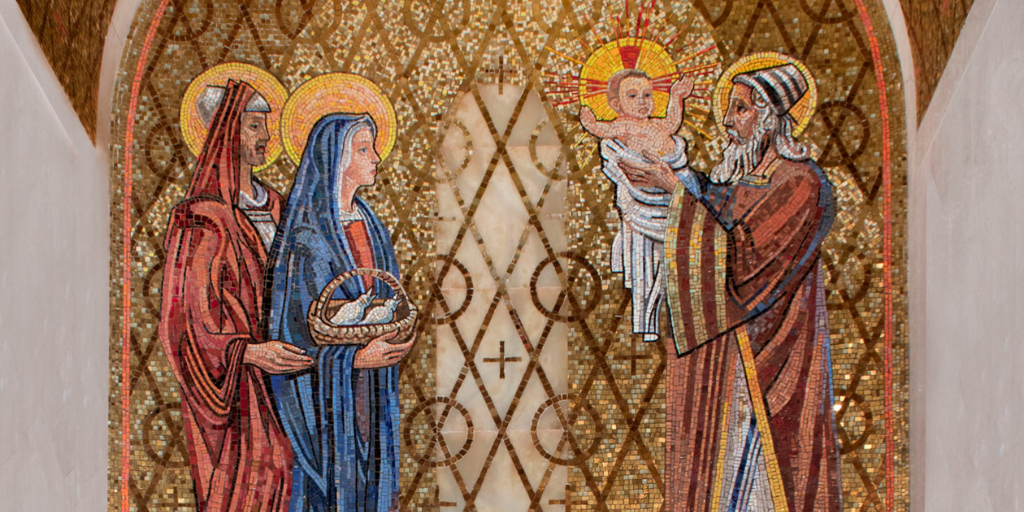
Located in the West Apse of the Great Upper Church, the Presentation Chapel portrays the moment when Joseph and Mary brought Jesus to the Temple in Jerusalem to consecrate Him to God according to the law. While they were in the Temple, they were approached by a righteous old man named Simeon, to whom the Lord had made a promise: he would see the Savior before he died. When Simeon received Jesus, he took Him in his arms, blessed Him, and prophesied His future as Savior.
At the Temple, Mary and Joseph also met a widow and prophetess named Anna, who praised God when she saw the Infant Jesus. Just like Simeon, Anna was faithful, visiting the temple and praying often, watchfully waiting for the redemption of Israel. And like Simeon, she too was rewarded for her faithfulness, given the privilege of recognizing Jesus’ Lordship as Messiah.
Ultimately, the Presentation reflects how Christ fulfills the Old Covenant, serving as the foretold Messiah. In the lower portion of the mosaic, this consonance is reflected with a portrayal of the Old Testament parallel of Hannah presenting her son Samuel to the priest and dedicating him to the Lord’s service, as described in 1 Samuel 1:24-28. Between the two portrayals is the text: “According to the law, they presented him.”
February 5 – The Saint Agatha Chapel
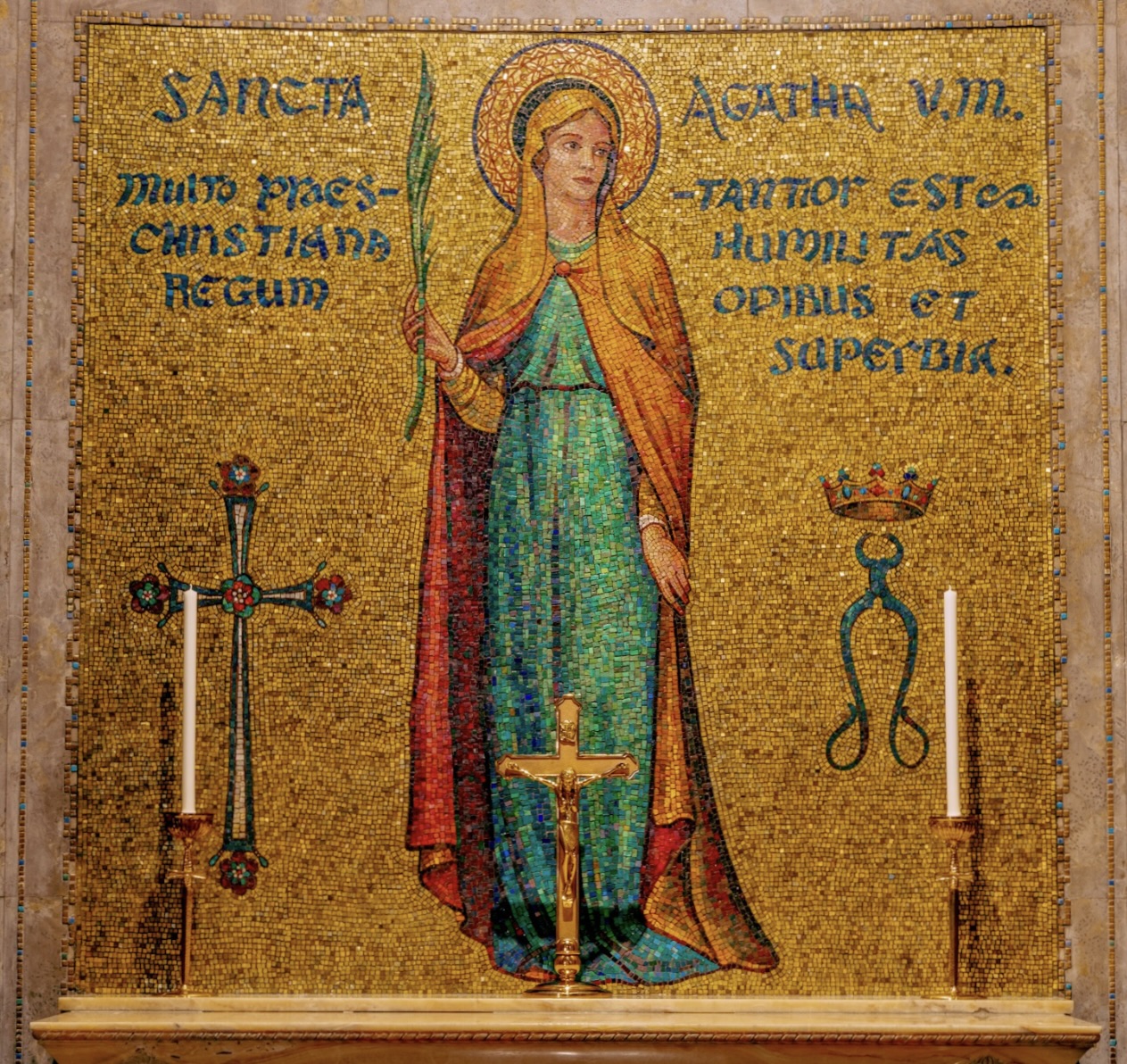 Known for standing firm in her faith amidst persecution and torture, Saint Agatha is recognized as the patroness of those suffering from breast cancer and disease. While there are limited historic accounts of Agatha’s life, it is believed that she was born near Mount Etna in Sicily to an affluent nobleman in approximately A.D. 235. As a young girl, she underwent the ritual of “velatio” (taking the veil) to mark herself as a virgin for Christ, receiving a red veil as a symbol of her promise. After spurning the advances of a Roman official, she was subjected to torture and persecution, and ultimately went to be with the Lord on February 5, A.D. 251.
In the West Apse of the Crypt Church, Saint Agatha is portrayed in a shimmering mosaic chapel, along with five other women who are remembered in Eucharistic Prayer I, the Roman Canon. In this depiction, her mantle falls gently over her shoulders, providing a warm contrast to the emerald tones of her robe. To her right is a budding cross, and to her left, a crown and a pair of pincers. The Latin text on the mosaic translates:
“Christian humility is far more distinguished than the wealth and pride of kings.” — Matins, II Nocturne, Lesson IV
February 11 – The Our Lady of Lourdes Chapel
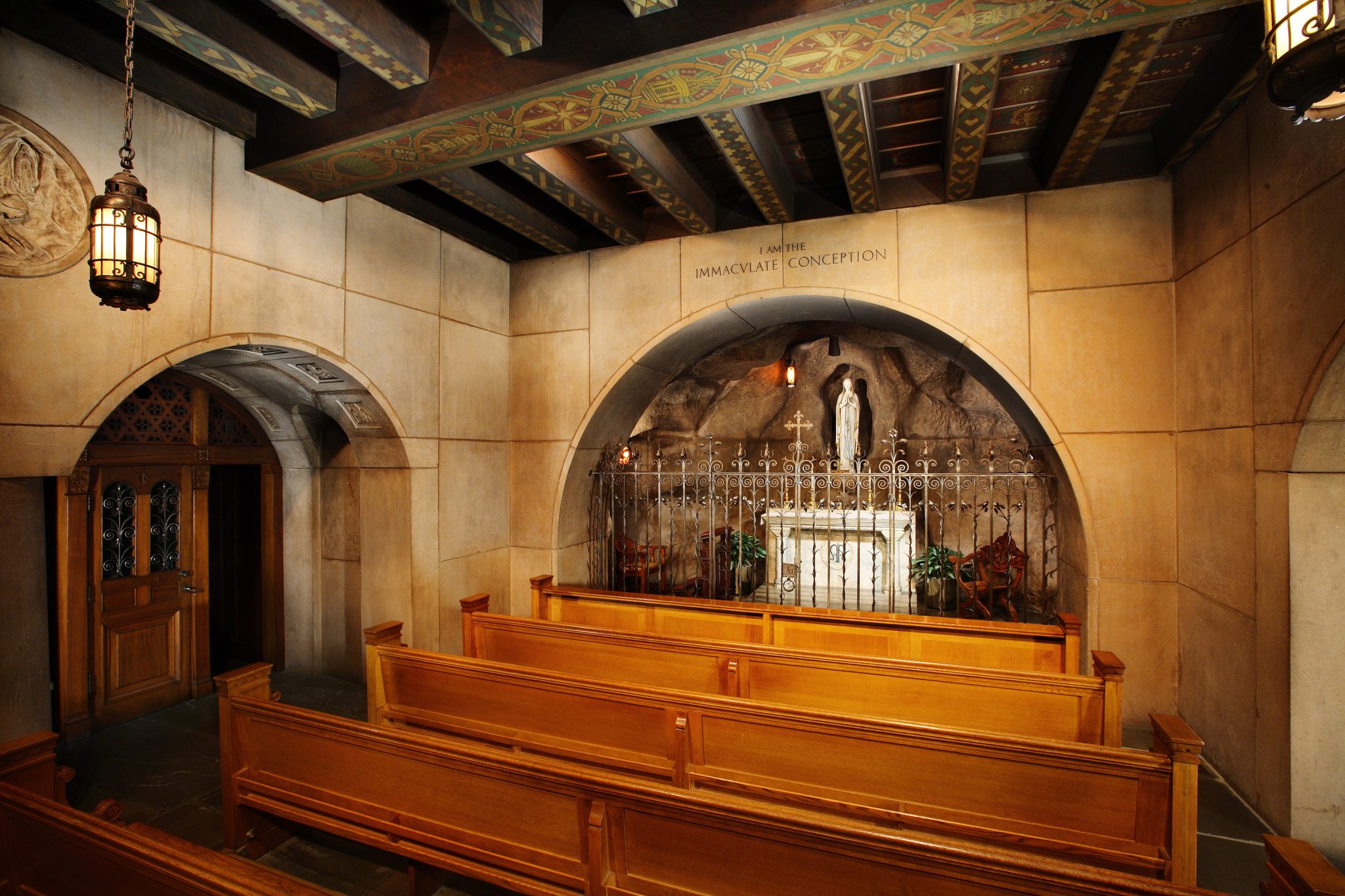 Did you know the Chapel of Our Lady of Lourdes is the oldest chapel in the Basilica? Gifted by George Logan Duval, it replicates the Grotto of Massabielle in Lourdes, France, and features an ivory-colored statue of Our Lady. In this portrayal, the Blessed Mother holds a rosary, and gold roses grace her feet. Her mantle falls in soft lines around her, evoking a sense of serenity. Above the wrought iron gate is carved the phrase the Blessed Mother spoke to St. Bernadette: “I am the Immaculate Conception.”
Limestone rondels featured on different walls of the chapel tell biblical miracles paralleling the miracles recorded at Lourdes. On the right-side wall, the rondel portrays Moses striking the rock in the desert, from which water miraculously flowed (Numbers 20:11). The two rondels on the back wall illustrate Jesus healing the blind and lame at the Pool of Bethesda (John 5:2-9), and Jesus restoring life to the daughter of Jairus (Mark 5:21–43; Luke 8:40–56). This chapel remains one of the most popular chapels at the Basilica.
Sources:
Rohling, Geraldine M., PhD, MAEd. The Basilica of the National Shrine of the Immaculate Conception: Guide and Tour Book. Washington, D.C.: Basilica of the National Shrine of the Immaculate Conception, 2018.
“Saint Agatha,” Franciscan Media.
“St. Agatha, Virgin and Martyr,” Vatican News.